
Omnichannel Customer Support: Platform, Strategy, & Customer Service
In today’s fast-paced world, providing an excellent customer service experience is more important than ever. Customers expect personalized service that caters to their specific needs and preferences. Seamless support experience is crucial for maintaining high service quality across every customer interaction, whether they contact support via chat or other channels.
📑 Table of Contents
- Omnichannel Customer Support: Platform, Strategy, & Customer Service
- Key highlights
- Understanding Omnichannel Customer Support
- Difference Between Omnichannel and Multichannel Customer Service
- Key Components of an Omnichannel Customer Support Platform
- Benefits of Omnichannel Customer Support
- Implementing an Omnichannel Customer Service Strategy
- Examples of Omnichannel Customer Service in Action
- Lessons Learned from Omnichannel Customer Service Examples
- The Power of Omnichannel Customer Service
- When Does a Business Need an Omnichannel Customer Service Strategy?
- Frequently Asked Questions (FAQs)
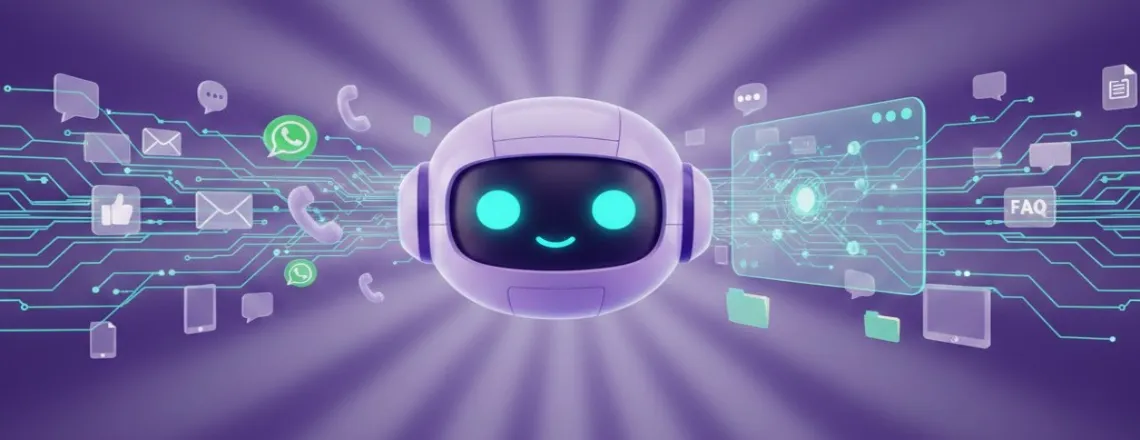
That’s where omnichannel customer support comes in to streamline the support experience and enhance service quality across every interaction. This article explores what omnichannel customer support is, how it differs from multichannel support, and the key components of a successful omnichannel strategy. You’ll also discover the numerous benefits of omnichannel customer service boosts, including improved customer satisfaction and increased customer loyalty, which are essential for a unified view of customer interactions across channels.
Key highlights
| Seamless customer interactions across all service channels Unified customer data improves support quality Faster resolutions through centralized omnichannel workflows AI automation boosts efficiency and customer satisfaction Consistent experiences strengthen loyalty and retention |
Understanding Omnichannel Customer Support
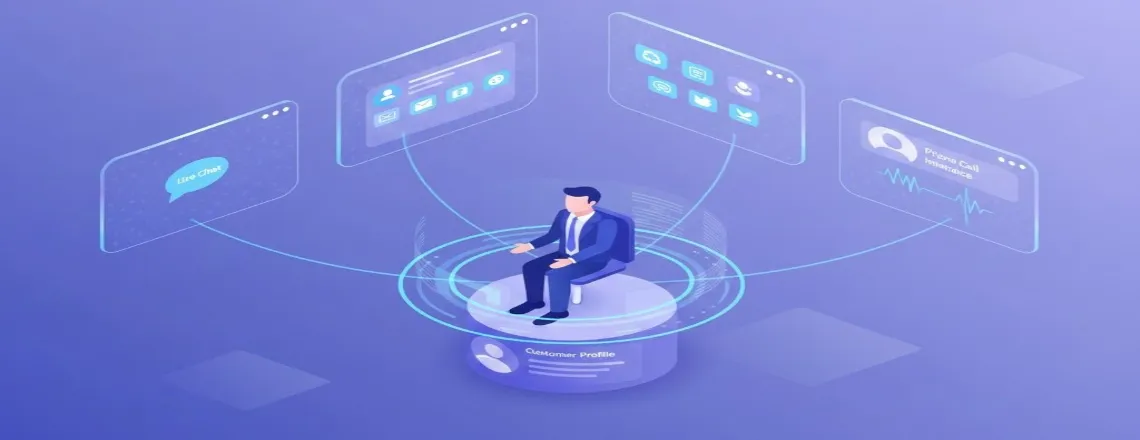
Omnichannel customer support is a unified approach to delivering service across every communication channel your customers use: live chat, email, social media, SMS, phone, and messaging apps. Unlike traditional setups where each channel works independently, an omnichannel system connects all interactions into one continuous conversation. This gives support teams a 360° view of the customer, allowing them to pick up where the last interaction ended, no matter which channel the customer switches to.
This omnichannel approach ensures a seamless and efficient customer journey. Modern platforms often integrate AI chatbots and automation to handle routine inquiries across multiple channels, ultimately leading to higher customer satisfaction and stronger customer loyalty.
What is Omnichannel Customer Support?
Omnichannel customer support is all about creating a unified and consistent customer experience across all available channels. It means providing support across various platforms like live chat, email, social media, and phone, ensuring that all customer conversations across channels are connected to enhance customer satisfaction.
The goal is to give the support team a complete view of customer history, so they can deliver personalized support and improve the overall support experience. With omnichannel customer support, customers can start a conversation on one channel and continue it on another without having to repeat themselves. This omnichannel approach ensures a seamless and efficient customer journey, ultimately leading to higher customer satisfaction and stronger customer loyalty.
Difference Between Omnichannel and Multichannel Customer Service
While both omnichannel and multichannel support involve using multiple channels to communicate with customers, there’s a key difference in how they manage customer context. Multichannel customer service simply means having a presence on various channels, but these channels operate independently. Omnichannel customer service integrates these channels to provide a unified and consistent experience that addresses every customer and tracks customer needs effectively.
In a multichannel setup, customer profiles might be siloed, meaning agents on different channels don’t have a complete view of the customer. With omnichannel, all customer data is connected, allowing agents to personalize support based on a unified view of customer interactions across previous customer interactions. This integrated omnichannel strategy ensures a smoother and more satisfying customer experience compared to the disjointed nature of multichannel support, providing a true omnichannel customer experience.
Key Components of an Omnichannel Customer Support Platform
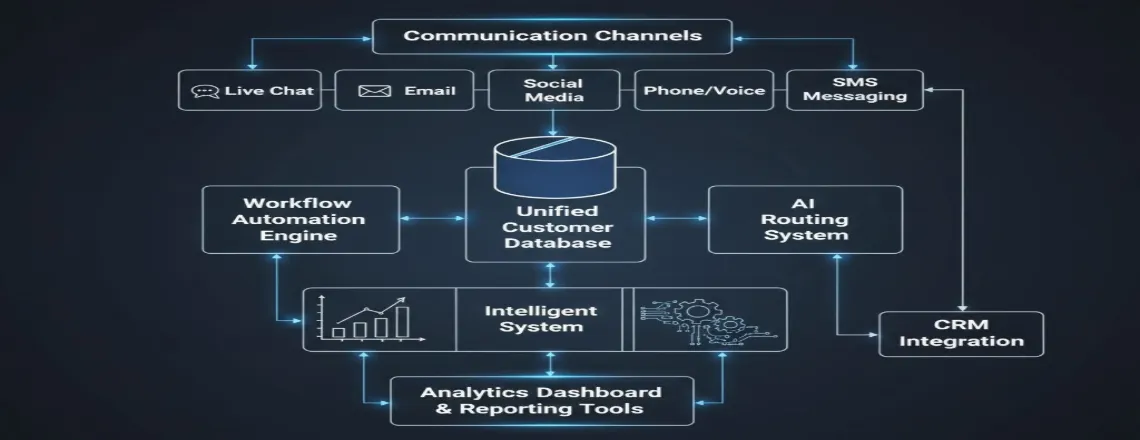
An omnichannel customer support platform is the backbone of a successful omnichannel strategy that enhances customer satisfaction and loyalty. It’s a support system that integrates all communication channels into a single interface, giving agents a 360-degree view of the customer. Key components include:
A centralized customer database, which stores all customer information and interaction history.
Real-time support tools, such as live chat and co-browsing, enhance customer satisfaction by enabling immediate assistance across all customer interactions.
Workflow automation helps streamline tasks and ensure a consistent level of service across all channels. Reporting and analytics tools provide insights into customer behavior and support performance, allowing businesses to continuously improve customer engagement and optimize their omnichannel experience. Ultimately, a strong omnichannel platform empowers businesses to deliver exceptional customer service and enhance customer satisfaction across every customer touchpoint.
Benefits of Omnichannel Customer Support

Enhanced Customer Experience
Omnichannel support creates a better customer experience by making it easy for customers to contact support whenever they need it, ensuring service across every channel. When all your support channels work together, customers can switch between them without having to repeat their questions or information. This makes the entire customer journey smoother and more convenient.
For example, a customer might start a conversation with a chatbot for sales on your customer engagement platform and then continue it with a live agent on the phone, all while the agent has access to the full customer history. This consistent service and ability to deliver personalized support lead to higher customer satisfaction and stronger customer loyalty, as omnichannel customer service connects with customers effectively. An improved omnichannel experience shows customers that you value their time and are committed to providing excellent customer service across all customer interactions.
Increased Customer Satisfaction
One of the key benefits of omnichannel customer service is increased customer satisfaction, which is crucial for a successful support strategy. When customers can easily reach you through their preferred channels and receive consistent service, they are more likely to be happy with their overall experience. An omnichannel approach ensures that customer interactions across channels are seamless and that support agents have access to all the necessary customer data across channels to deliver personalized support. This reduces frustration and improves the efficiency of the support process by providing a unified view of customer data.
Higher customer loyalty and satisfaction often translate into increased customer loyalty and positive word-of-mouth, which can significantly boost your business. By focusing on the omnichannel experience, you can create a more positive and satisfying customer journey that keeps customer loyalty and enhances service quality across every interaction.
Improved Efficiency for Support Teams
Implementing an omnichannel strategy not only benefits customers but also enhances service quality across every channel. Improving the efficiency of support teams is essential for maintaining high service quality and meeting customer needs. With an omnichannel customer support platform, agents have a centralized view of customer interactions, enabling them to provide faster and more effective assistance, ultimately improving customer satisfaction scores. This support system helps reduce the time spent searching for customer information and allows support agents to personalize support based on a complete view of customer interactions through omnichannel communication.
Workflow automation can streamline repetitive tasks, freeing up agents to focus on more complex issues that require a strong omnichannel strategy. By optimizing the support process, businesses can reduce operational costs and improve the overall productivity of their support team. Ultimately, a strong omnichannel platform empowers agents to deliver exceptional customer service, leading to both higher customer satisfaction and improved team performance.
Implementing an Omnichannel Customer Service Strategy
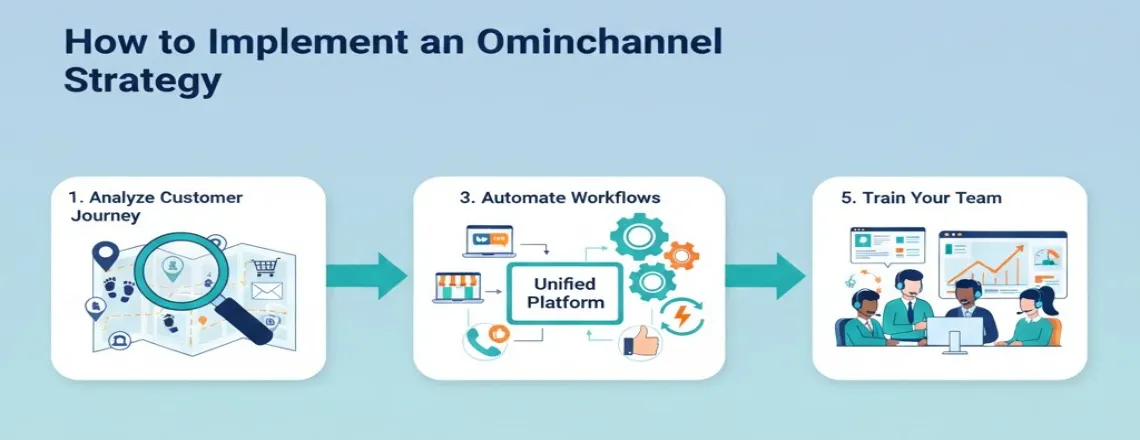
Steps to Develop an Omnichannel Strategy
An effective omnichannel strategy requires careful planning and execution to ensure seamless customer interactions across multiple channels, providing support across every touchpoint. Key steps in this process include:
Understand your customer journey to enhance your support strategy. Map out all the touchpoints where customers interact with your business, from your website to social media.
Gather customer data from all channels to get a complete view of the customer. This will help you personalize support and tailor your omnichannel approach.
Set clear goals for your omnichannel customer service, such as improving customer satisfaction or increasing customer loyalty, to develop a strong omnichannel strategy. Choose the right technology and support system to implement your strategy and maintain high service quality. Finally, train your support team to effectively use the new omnichannel platform and provide consistent service across all channels. This thoughtful approach ensures a seamless support experience, and an effective omnichannel system helps teams deliver exceptional service for your customers.
Choosing the Right Omnichannel Customer Support Platform
Selecting the right omnichannel customer support platform is crucial for delivering excellent customer service and ensuring a unified view of customer data. Look for a platform that integrates all your communication channels, such as live chat, email, social media, and phone, into a seamless support experience. The platform should provide a unified view of the customer, giving agents access to customer history and a comprehensive view of customer interactions across channels. It should also offer features like workflow automation and real-time support to improve efficiency and customer engagement, as businesses need an omnichannel approach to achieve these goals.
Make sure the platform is scalable and can adapt to your business needs as you grow. Consider factors like ease of use, integration capabilities, and cost when making your decision to meet customer needs across every customer touchpoint. The right omnichannel platform empowers your support team to personalize support and create a seamless omnichannel customer experience that tracks customer interactions effectively.
Training Your Team for Omnichannel Support
Training your support team is essential for the successful implementation of an omnichannel customer service strategy. Ensure that your agents understand the benefits of omnichannel customer service and how it differs from multichannel support. Teach them how to use the omnichannel customer support platform effectively, including accessing customer data and managing customer interactions across channels to ensure a seamless support experience.
Emphasize the importance of providing consistent service and personalizing support based on customer history. Provide training on communication skills and how to handle different types of customer inquiries. Encourage your team to collaborate and share knowledge to improve their overall performance and enhance the customer service experience. By investing in proper training, you can empower your support team to deliver exceptional omnichannel customer experience and achieve higher customer satisfaction and loyalty scores with the right omnichannel contact center software.
Examples of Omnichannel Customer Service in Action

Successful Brands Using Omnichannel Support
Many successful brands use omnichannel customer support means to create great customer experiences. These companies understand that providing support across multiple channels is not enough; they need to ensure that all customer interactions are connected to create a better support experience.
For instance, a clothing retailer might use live chat on its customer engagement platform to help customers with immediate questions, while also using social media to address broader inquiries and concerns across all customer interactions. This approach works particularly well for ecommerce businesses using chatbots to bridge online and offline experiences, ensuring customers receive consistent service regardless of how they shop
When a customer contacts them, the support team can see all past interactions. The key is to use the omnichannel platform to see all customer data and give personalized support. This strong omnichannel approach leads to higher customer satisfaction and customer loyalty, as customers feel valued and understood through consistent support experiences. This consistent service helps them to improve customer relationships in the long run through a strong omnichannel strategy.
Real-Life Omnichannel Customer Experience Scenarios
To really understand the benefits of omnichannel customer service, let’s look at some real-life scenarios. Imagine a customer browsing a website and adding items to their cart but not completing the purchase. With an omnichannel strategy, the company can send a personalized email reminding the customer about the items in their cart. If the customer then calls customer service with questions, the agent can see the email that was sent and provide relevant assistance. Or, think about a customer who reports an issue on social media, which could be addressed by your customer service provides across all channels.
The support team can respond quickly and then follow up via email to resolve the issue privately, ensuring a complete view of customer interactions. These omnichannel customer service examples help the customer feel supported and valued at every customer touchpoint. They also create a seamless customer journey and improve customer engagement through a true omnichannel customer experience.
Lessons Learned from Omnichannel Customer Service Examples
Studying omnichannel customer service examples can teach us valuable lessons about what works and what doesn’t in the realm of complex customer interactions. One key takeaway is that a successful omnichannel strategy requires a deep understanding of the customer journey. Businesses need to identify all the points where customers interact with them and make sure that these interactions are consistent and connected. Another lesson is the importance of having the right omnichannel customer support platform. This platform should integrate all communication channels and provide a unified view of the customer context. Finally, training the support team is essential.
Agents need to know how to use the omnichannel platform effectively and how to deliver personalized support across all channels. By learning from these examples, businesses can implement an omnichannel approach that truly improves the customer experience and drives customer loyalty, and make a better multichannel customer service.
The Power of Omnichannel Customer Service
Omnichannel vs. Multichannel Customer Service
Multichannel customer service means offering support across different channels like email, chat, social media, and phone, but each channel works separately. Customers often have to repeat information because conversations aren’t connected, making the experience fragmented and inconsistent.
Omnichannel customer service, on the other hand, connects all channels into one unified system. Agents can see a customer’s entire history across chat, email, social, and messaging apps, allowing conversations to continue seamlessly. This creates faster responses, less customer frustration, and a more personalized, smooth support experience that builds long-term loyalty.
Omnichannel Customer Service Examples and Use Cases
Omnichannel customer service works best when businesses connect conversations across all channels, chat, email, phone, social media, messaging apps, and in-app support. A common use case is retail, where a customer starts browsing online, asks a question through live chat, and then completes the purchase in-store with full context accessible to staff. Another example is a telecom company letting customers report an issue on WhatsApp, receive updates via SMS, and get final confirmation by email without repeating the problem.
These examples show how omnichannel removes friction by preserving context. Any business handling high conversation volume ecommerce, banking, healthcare, SaaS, or travel uses omnichannel systems to offer faster responses, reduce frustration, and ensure every interaction builds on the one before it.
The Key Benefits of an Omnichannel Support Strategy
The biggest benefit is consistency. Customers no longer need to re-explain their issue when switching from chat to phone or from social media to email. This reduces frustration and builds trust. With all channels connected, agents work faster because they have full visibility into past conversations, customer history, and preferences.
Another advantage is higher customer satisfaction and retention. When customers feel supported wherever they reach out, they are more likely to stay loyal. Businesses also improve internal efficiency because automation, routing, and centralized dashboards reduce manual work and shorten resolution times. Overall, omnichannel support leads to better experiences at a lower operational cost.
AI Agents for Concierge Customer Experience
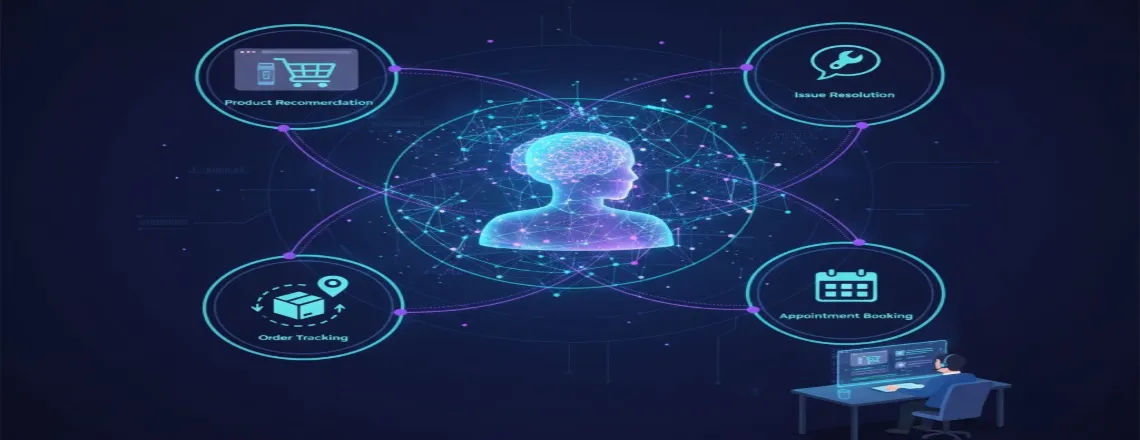
AI agents act like digital concierges, guiding customers through tasks such as product recommendations, issue reporting, order tracking, or booking appointments. They understand customer intent and context across channels, enabling them to pick up conversations instantly, even when the customer switches from website chat to WhatsApp or the mobile app. These AI agents remove repetitive work from human teams by handling FAQs, triage, and routing. Organizations looking to master customer service with AI chatbots can leverage these tools to scale their support operations while maintaining personalization.
These AI agents remove repetitive work from human teams by handling FAQs, triage, and routing. When the issue is complex, the AI seamlessly hands off the conversation to a human agent with full context preserved. This leads to faster service, fewer mistakes, and more personalized experiences at scale.
How to Implement an Omnichannel Strategy
Start by mapping your customer journey. Identify where your customers contact you and where conversations usually break down. Next, choose an omnichannel platform that connects all key channels, live chat, email, messaging apps, phone, and social media into a unified inbox. Integrate it with your CRM so agents always have access to customer history and context. Then, add automation for routing, FAQs, and proactive notifications. Modern chatbot platforms offer these capabilities out of the box, making implementation faster and more efficient.
Then, add automation for routing, FAQs, and proactive notifications. Train your support team to use the new system, especially on how to handle cross-channel conversations. Monitor performance metrics like resolution time, CSAT, and channel usage. Continue refining workflows based on real customer behavior to ensure the experience stays smooth and consistent.
When Does a Business Need an Omnichannel Customer Service Strategy?
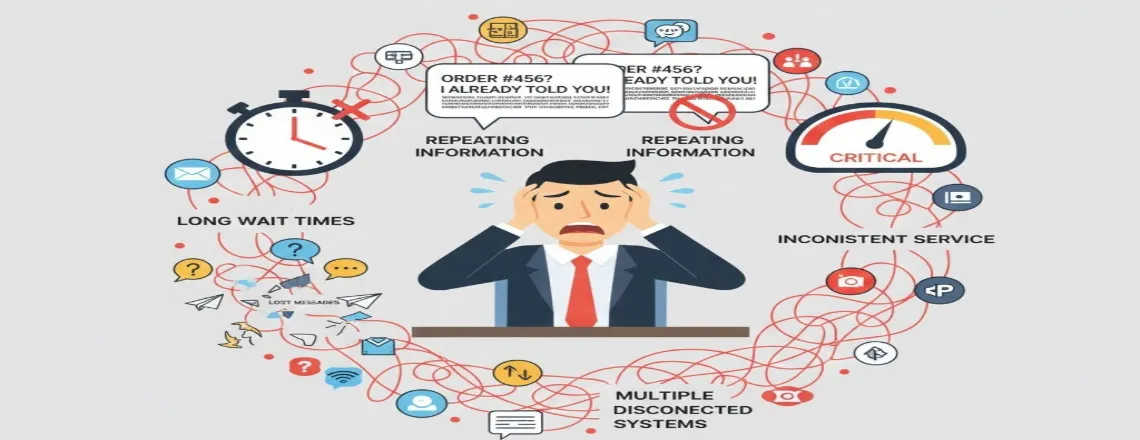
A business needs omnichannel support when customers start using multiple channels to reach out, and the team struggles to track conversations. Signs include repeated customer information, lost messages, slow response times, and inconsistent service quality. If customer satisfaction drops or agents feel overwhelmed jumping between tools, it’s time to switch to omnichannel.
Growing companies especially benefit because conversation volume increases across platforms like WhatsApp, Instagram, email, and website chat. When these channels operate separately, mistakes happen. An omnichannel strategy becomes necessary to maintain speed, accuracy, and a seamless experience as the business scales.
Frequently Asked Questions (FAQs)
Omnichannel chat support provides seamless, consistent chat experiences across all customer touchpoints without losing context.
Multichannel = separate channels. Omnichannel = integrated channels with shared context and continuity.
Improved satisfaction, higher FCR, better efficiency, unified analytics, and increased conversions.
Website chat, in-app chat, WhatsApp, Messenger, SMS, email, and AI chatbots.
Unified platforms, CRM integration, AI bots, routing engines, analytics dashboards, and APIs.
Audit channels → choose platform → integrate CRM → design handoff rules → deploy bots → train agents → track KPIs.
Response time, FRT, resolution time, FCR, CSAT/NPS, handle time, channel usage, and bot containment.
Automation, 24/7 support, intelligent routing, knowledge surfacing, and context continuity.
Integration issues, context loss, privacy concerns, agent training, change resistance. Solutions: APIs, unified views, training, and phased rollout.
Use encryption, secure APIs, access controls, retention policies, and compliance with GDPR/CCPA/HIPAA.
Measure wait time, resolution time, customer ratings, and chat volume.
A unified chat system showing WhatsApp, Messenger, Instagram, SMS, and website chats in one dashboard.
Consistency, Convenience, Context, and Continuity.
A synced communication strategy where messages and customer data stay aligned across all channels.
Support across all platforms without customers repeating their issue.
It eliminates friction, speeds resolutions, and increases loyalty.
Identify where conversations break, context is lost, customers repeat themselves, or handoffs fail.
Yes — seamless and personalized experiences increase trust and retention.
Identify channels → unified inbox → CRM sync → automation → agent training → analytics optimization.
Centralizes messages, automates tasks, stores customer data, and routes chats efficiently.
Reduces workload, eliminates repetition, improves productivity, and shortens resolution time.
Data silos, poor integration, inconsistent messaging, limited training, and slow responses.
Starbucks, Sephora, Amazon, Apple, and Nike.
Website chat, email, phone, WhatsApp, Messenger, Instagram DM, SMS, in-app chat, chatbots, and self-service portals.
Support offered on multiple platforms but without shared context.
A connected support system where context and conversation history follow the customer across channels.
Customers expect fast, consistent, and personalized support without repeating information.
Lower support costs, higher retention, increased conversions, and improved productivity. Track via cost per contact, revenue uplift, and CLV.

Daniel Wong
Technical Content Writer
My name is Daniel Wong, a Technical Content Writer from Singapore with a strong interest in AI-powered tools and digital automation. At ChatBoq AI, I focus on creating practical and easy-to-follow content that helps businesses and individuals understand how chatbots work and how to use them effectively.
I enjoy breaking down complex topics like natural language processing (NLP) and conversational AI into simple guides that anyone can follow. Each article is based on careful research, real-world examples, and testing to ensure accuracy and reliability.
Through ChatBoq AI, my goal is to provide readers with trustworthy insights, step-by-step tutorials, and the latest trends in chatbot technology.
✍️
Expert in AI & Chatbot Technology

Leave A Comment