
How to Build an FAQ Chatbot That Boosts Customer Satisfaction?

Late at night, a client checks your website, asking about your return policy. On your FAQ page, they cannot locate it, and your staff won’t be free till the morning. Angry, they leave the site and perhaps your company as well.
📑 Table of Contents
- How to Build an FAQ Chatbot That Boosts Customer Satisfaction?
- Key highlights
- What is an FAQ chatbot?
- Benefits of an FAQ chatbot
- Types of Faq chatbots
- Real-world use cases of FAQ chatbots:
- Step-by-step Guide to build an FAQ chatbot
- Challenges and how to overcome them
- Best practices for FAQ chatbots
- Future trends in FAQ chatbot
- Conclusion
- Frequently Asked Questions (FAQs)
This case is too frequent. Customers now demand immediate answers in today’s digital-first society. Standard answers, such as static FAQs or overworked human agents, just do not work anymore.
A conversational artificial intelligence (CAI) tool created to automatically answer commonly asked questions, or an FAQ chatbot for short, is meant to aid in this process. Imagine it as your FAQs page but smarter, quicker, and always open. From “What are your business hours?” to “How do I reset my password?”, these bots provide fast and accurate answers, hence reducing human errors, freeing your assist team to concentrate on challenging questions.
Actually, studies indicate that providing round-the-clock service and cutting support expenses by up to 40% could be accomplished by companies employing AI-powered chatbots. Even better, businesses that include chatbots in their customer journey see greater engagement, quicker answer times, and better conversions.
You will have a definite plan for creating and deploying an FAQ chatbot that improves customer experience, lowers expenses, and futureproofs your support plan by the end.
Key highlights
| An FAQ chatbot is designed to handle users’ FAQs. Transform businesses by automating repetitive queries. Chatbots each have their own variation and real-time usage. |
What is an FAQ chatbot?
Designed expressly to handle user-frequently asked user questions, an FAQ chatbot is a sort of chatbot. Acting as a virtual assistant, it offers immediate, automatic replies to frequently asked questions.
How it works
Using a predetermined knowledge base will give essentially a collection of questions and their appropriate answers. This shows the process of how an FAQ chatbot operates. The chatbot examines the question a user submits to identify the hardest response.
Standard chatbot versus FAQs chatbot
Although all chatbots are meant to automate engagements, FAQ chatbots play a unique purpose: managing often asked, repeatable questions.
Reasons they are significant
Nowadays, consumers demand instant gratification. Research reveals that 82% of consumers expect answers right away when they have questions.
Benefits of an FAQ chatbot
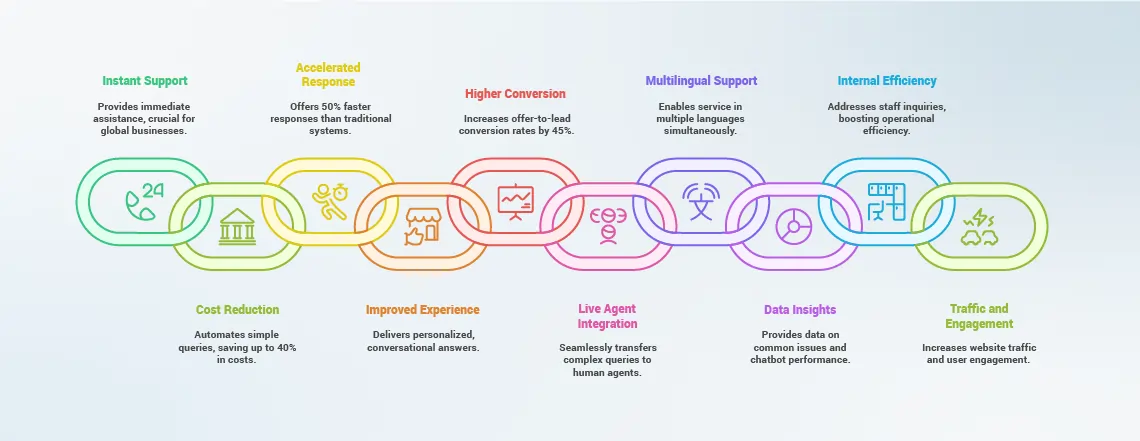
FAQ is a strategic tool that helps transform how businesses deliver customer support by automating repetitive queries. These bots provide immediate assistance, improve customer satisfaction, and reduce labour. Here are some of the benefits that the FAQ chatbot provides in thorough detail:
1. Instant support every time
FAQ chatbots are artificial intelligence-powered bots that are always available, responding to client inquiries 24/7. This is especially important for worldwide businesses operating in different time zones.
2. Less support costs
Chatbots remove human agents to handle complex tasks by automating simple inquiries. Companies like Google and IBM have stated that chatbot implementation can save up to 40%. For customer service teams, this makes chatbots the most financially sensible purchase.
3. Accelerated reaction times
AI-powered chatbots can give replies 50% quicker than conventional support systems. Higher customer satisfaction results from the elimination of wait times, which also prevents consumers from abandoning their path due to frustration.
4. Improved Customer Experience
Clients despise having to search static frequently asked questions pages or waiting on hold. A chatbot provides them immediate, customized, conversational answers. FAQ bots’ interactive design helps the experience seem effortless, natural, and frustration-free.
5. Higher Conversion Rates
Chatbots help consumers toward action; they don’t simply answer queries. Companies like Sanlam utilized Voiceflow to create an FAQ chatbot, which increased their offer-to-lead conversion rate by 45%. Direct increases in revenue and sales result from chatbots by decreasing friction.
6. Perfect Incorporation with Live Agents
Occasionally, a bot may not be able to answer everything; that is acceptable. An intelligently designed FAQ chatbot guarantees clients never feel stalled or forgotten by automatically assigning sophisticated questions to live support agents.
7. Support for multiple languages
For global businesses, chatbots support multiple languages simultaneously. This guarantees inclusion, allowing companies to offer uniform service to overseas clients without requiring multilingual support personnel.
8. Insights Based on Data
Each chatbot interaction produces insightful data. Organizations can monitor:
- Most often asked questions.
- Common consumer issues.
- Resolving rate among chatbot performance measures.
These observations enable businesses to refine their overall customer service approach, as well as their chatbot.
9. Efficient Internal Procedures
Although FAQ chatbots are intended for both employees and clients. Internal bots can address staff inquiries about business processes, IT troubleshooting, or HR policies. Companies that utilize AI-driven engagement platforms report a 25% increase in operating efficiency.
10. Higher Traffic and Engagement
Including bots in apps and websites can help to generate more user engagement. Parkfield Commerce, for instance, enabled a client to increase website traffic by almost 73% just by deploying an artificial intelligence chatbot solution.
Types of Faq chatbots
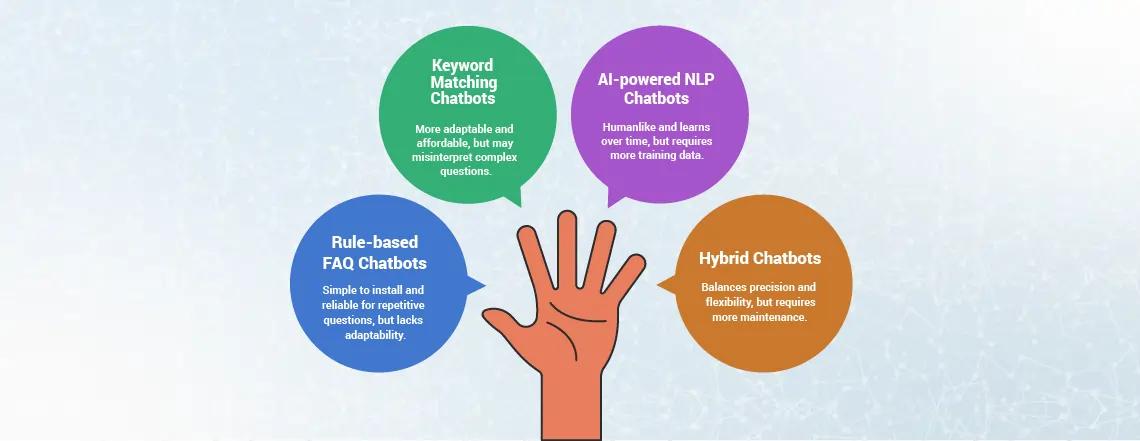
Based on the variation in business, there are various types of FAQ chatbots. There are four different Faq chatbots, each with its unique strengths and weaknesses that can be described as follows:
1. Rule-based FAQ Chatbots
Usually referred to as menu-based or decision tree bots, these are the simplest type of bots.
They adhere to specified “if–then” guidelines in their operation.
Benefits:
- Simple to install, requiring no specialist knowledge.
- Dependable for repetitive, well-organized questions.
Restrictions:
- Not capable of dealing with changes in wording.
- Difficulties with complicated or unanticipated questions.
Consider them like a vending machine—ideal if you know exactly what you want, but not expecting surprises.
2. Chatbots for keyword matching
By searching for specific keywords in a user’s query, these bots take it one step further.
How they operate: The bot scans its database for “refund” if a customer types it, then matches it with the appropriate answer.
Best for:
- Companies handling basic yet diverse inquiries.
Benefits:
- More adaptable than rule-based bots.
- Fast to mature and affordable.
Constraints include:
- Questions with several keywords could be misinterpreted by May.
- Not contextually aware.
3. Chatbots driven by AIPower NLP
Ideal for medium to large corporations, SaaS platforms, or companies with various client inquiries.
Pros:
- Knows synonyms, forms, and even slang.
- Gains experience from interactions and grows over time.
- More humanlike and conversational.
Restrictions:
- Needs more training data and a broader knowledge base.
- More intricate to put into practice.
4. Hybrid Chatbots
Why select one when you can blend the greatest of both worlds? Rule-based mechanisms and artificial intelligence combine in hybrid robots.
Simple questions are answered right away with pre-defined replies; more complicated ones are processed using NLP.
Ideal for companies seeking both scalability and reliability.
Advantages:
- Balances dexterity, precision, and flexibility.
- It can change with the company’s expansion.
Limits:
- Increased maintenance and more sophisticated design.
Real-world use cases of FAQ chatbots:
FAQ chatbots are adaptable solutions useful in several sectors.
- E-commerce: Bots help with cart recovery, returns, shipping, and product information. Example: Drake Waterfowl manages 50% of customer support using artificial intelligence, resulting in no adverse comments.
- Tech and SaaS: They cut ticket volume by managing onboarding, billing, and troubleshooting. Example: While maintaining a 93% CSAT score, Voiceflow’s “Tico” deflected 97% of support tickets.
- Finance and Banking: From fraud warnings to loan FAQs, robots lighten financial questions. Example: Sanlam Studios’ artificial intelligence coach solved complex financial issues with 100% accuracy.
- Education: Robots oversee enrollment, deadlines, and resources. Khan Academy’s “Khanmingo” customizes tutoring for pupils, for instance.
- Hospitality and Travel: They explain check-in rules, baggage policies, and cancellation procedures. Example: Millions of passengers are supported in many languages by AirAsia’s “AVA”.
Step-by-step Guide to build an FAQ chatbot
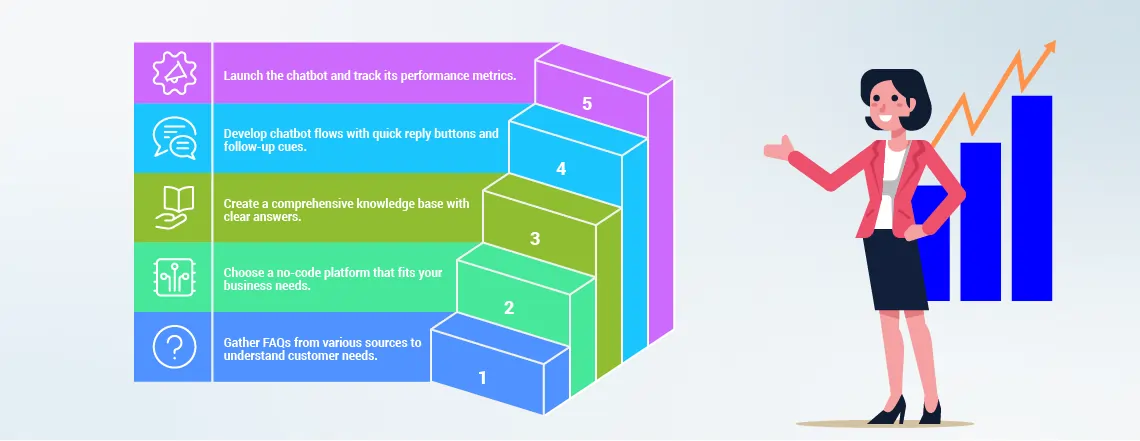
Thanks to the advanced technological development, building an FAQ chatbot in 2025 requires no coding knowledge. Nowadays, anyone with little or no knowledge of computing can create a chatbot within a matter of time. Here’s a guided step-by-step process to build an FAQ chatbot:
Step 1: Recognize Regular Customer Concerns
Your chatbot is only as good as the questions it can answer. Beginning by gathering FAQs from:
- Log entries for live chat and support tickets.
- Questions on social media and emails.
- Internal information bases or assistance desks.
Step 2: Pick a Chatbot Platform
With drag-and-drop interfaces, no-code platforms allow for simple chatbot development. Among the most used are:
- Voiceflow is excellent for creating multichannel bots with visual flows.
- Tidio: Simple for companies with internet connections.
- Chatfuel, ManyChat, WotNot: Perfect for social media or WhatsApp bots.
When making your choice, keep the following in mind:
- Integrations with your helpdesk, CRM, or e-commerce platform.
- Models of pricing (subscription versus pay-per-use).
- Future growth scalability
Step 3: Establish a Knowledge Base
Your bot’s knowledge base serves as its “brain.”
Prepare straightforward and brief replies for each frequently asked question.
Organize inquiries under several categories, including invoicing, shipping, and others.
Step 4: Design Chatbot Flows
This process involves an FAQ chatbot to qualify its flows and contents.
- Begin with your top twenty commonly asked questions, and then add according to actual use.
- To help customers, include fast reply buttons (e.g., “Shipping,” “Returns,” “Billing).
- For more context, design follow-up cues.
For instance, if someone inquires about shipping, the bot may ask, “Is this a local or international order?”
Step 5: Deploy & Monitor Performance
Once your bot is built, it’s time to launch. Deployment options include:
- Website widget
- Mobile apps
- Messaging platforms
After launch, monitor these key metrics:
- Resolution rate: % of queries solved without human help
- Transfer rate: % of queries handed to live agents
- Average conversation length: Measures efficiency and clarity
- CSAT (Customer Satisfaction Score): User feedback on interactions
Challenges and how to overcome them
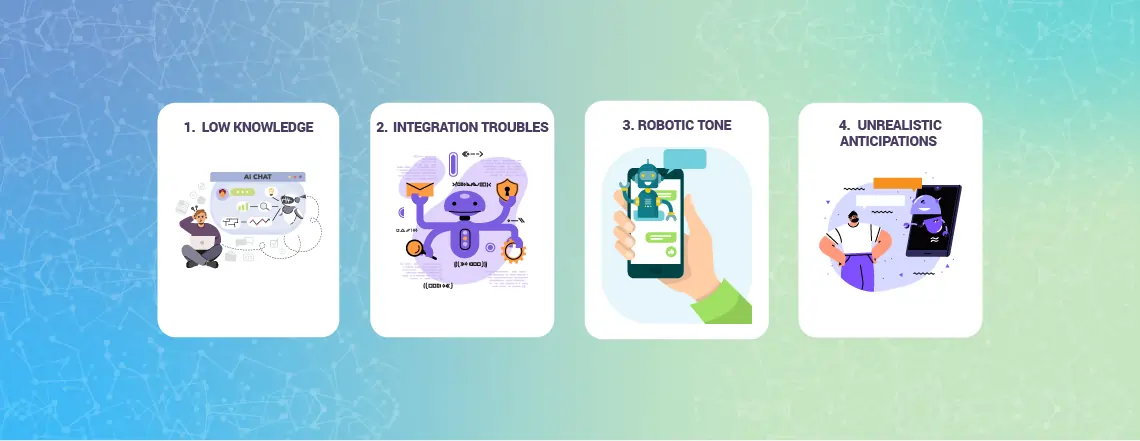
There are various challenges in FAQ chatbots and ways to overcome these hurdles that can be discussed as follows:
1. Low knowledge of complicated inquiries
Usually, fundamental bots struggle with complicated or multi-part questions. A rule-based chatbot could be perplexed.
For instance, a client inquires, “Can I change my shipping address after putting an international order?”
Solution:
- Refresh your knowledge base often, using actual customer inquiries.
- Use AI-powered natural language processing bots for improved contextual awareness.
- Offer backup messages such as “I’m not sure about that; I’ll put you with a support agent.”
2. Integration troubles
Friction results from a chatbot not connected to your CRM, support desk, or eCommerce platform. A customer might inquire, for example, about the status of their order, yet the bot cannot view order information.
Solution:
- Select systems with prebuilt connectors for products such as Salesforce, Zendesk, or Shopify.
- Work with APIs if you need deeper customisation.
3. Robotic Tone
Nobody wants to speak with a robot. Instead of helping users, they provide users with a poor conversational design that might frustrate them.
Answer:
- Answers should be written in a natural voice.
- Add brand personality by using greetings and emojis.
- Keep responses concise and straightforward to understand.
4. Unrealistic Anticipations
Certain companies anticipate chatbots to solve every customer problem. In reality, bots are best for predictable, repetitive queries.
Solution:
- Clearly define the limitations and abilities of your chatbot.
- Ensure that human agents receive a smooth handoff as necessary.
- Clear user communication.
Best practices for FAQ chatbots

To guarantee it offers constant value, you must improve, optimize, and upkeep it. The best procedures here are these.
1. Keep Material Current and Modern
Customer questions evolve in tandem with new goods, policies, and events. A dormant FAQ chatbot soon loses utility.
Best practice: Update replies, remove obsolete data, and include fresh FAQs through a review schedule.
2. Write like a person, not a machine.
Even if your chatbot is powered by artificial intelligence, it shouldn’t sound robotic. Customers relate more closely to spoken replies.
Best practice: Use open, friendly language that matches the character of your business. Instead of “Your query cannot be processed,” remark, “Hmm, I’m unsure about that, let me get you some help.
3. With fallback logic, prepare for the unforeseen.
Every chatbot cannot answer everything. The elegance with which it treats uncertainties is what counts.
Best practice: Use fallback messages like: “I don’t have that answer right now, would you like me to connect you with a live agent?” This maintains a good user experience and helps to avoid dead ends.
4. Combine Automation with the Human Touch
Speed is where chatbots shine; humans, however, excel in empathy. Any sensitive or complicated problem should always be referred to a live agent.
Best practice: At every point of the chatbot path, provide a simple “Talk to an agent” option.
5. Keep tabs on, analyze, then enhance
Good FAQ chatbots improve with experience. Gaps and opportunities should be identified through analytics.
Vital statistics to track are:
- Resolving frequency
- Drop-off points in dialogue
- Customer satisfaction ratings (CSAT)
Future trends in FAQ chatbot
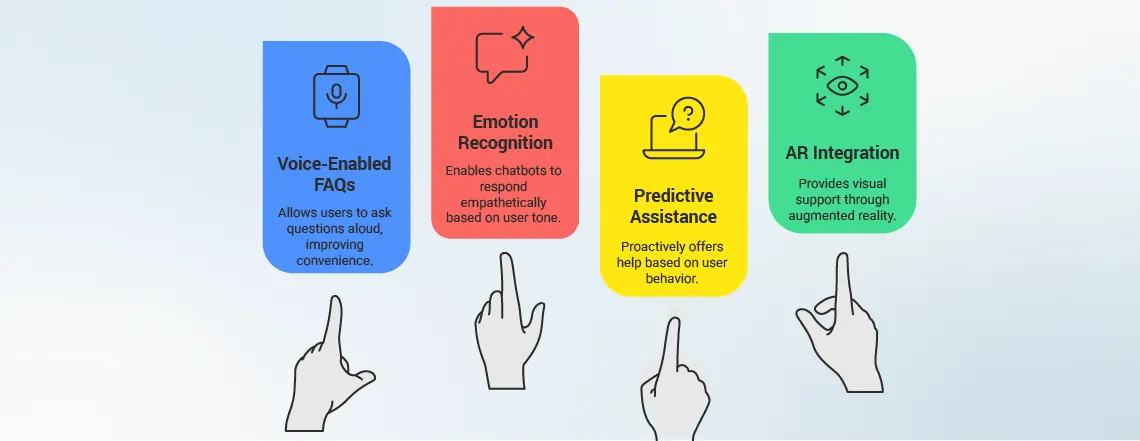
Tomorrow’s chatbots will be more interactive thanks to developments in machine learning and artificial intelligence. The primary developments that will determine their future are listed below.
1. Voice-enabled frequently asked questions chatbots
More consumers will expect to ask FAQs aloud as intelligent speakers and voice assistants become increasingly prevalent. Voice-enabled bots will let customers say, “What’s my order status?” instead of having to type it.
2. Recognizing Feelings
To detect frustration or bewilderment, next-generation chatbots will analyze user tone, word choice, and even typing speed. For instance, should a customer sound angry, the bot might react more sympathetically.
3. Predictive Assistance
Predictive bots will predict questions based on user behavior rather than expecting a client to inquire. A user surfing “returns” pages, for instance, could get a proactive chatbot message with return instructions.
4. Integrating Augmented Reality (AR)
Picture a chatbot layering augmented reality instructions on your phone to help you build furniture. This future use case combines FAQ replies with visual and physical support.
Conclusion
Nobody accepts lagging in today’s digital smart world. An FAQ chatbot enables customers to obtain immediate answers. This can be your reliable tool that is always at hand, always correct, never tired of answering the same questions. With its various features, including autonomy and ease of setup, this chatbot will automatically boost the sales rate of businesses.
Undoubtedly, it offers various advantages, including around-the-clock assistance, reduced expenses, quicker response times, and satisfied clients. Beyond efficiency, FAQ chatbots also drive conversions, recover abandoned carts, and strengthen brand loyalty. Whether you run an e-commerce site, SaaS platform, healthcare practice, or financial business, a chatbot can change the way you interact with clients. Tomorrow’s chatbots will be voice-enabled, emotionally intelligent, predictive, and capable of integrating with AR to provide practical support. By making investments now, companies can stay ahead of consumer expectations rather than meet them.
Most of all, creating one has never been easier. Using tools, you only need your FAQs, a crisp knowledge base, and some imagination to make a proper, human-like conversation flow that implies you don’t need to be an expert in it. Launch it, monitor performance, and progressively improve it over time. You will notice some superb results within months.
Welcome the strength of FAQs chatbots to protect your customer service plan for the future. Begin today and convert those late-night website users into devoted clients who value your always-on, flawless assistance.
Frequently Asked Questions (FAQs)
You can build one using no-code platforms like Tidio or ManyChat by uploading FAQs, designing conversation flows, and deploying it on your website. First, upload your FAQ list, then design conversations.
An FAQ bot is a chatbot designed specifically to answer frequently asked questions automatically.
Yes. With no-code tools, anyone can build a basic chatbot in hours without coding skills.
1. Define goals, 2. Identify FAQs, 3. Choose a platform, 4. Build a knowledge base, 5. Design flows, 6. Test & deploy, 7. Monitor & improve.
Chatbots give instant answers instead of forcing users to scroll through static text.
There are four main types of chatbots that are: 1. Rule-based, 2. Keyword-matching, 3. AI-powered (NLP), 4. Hybrid chatbots.
Yes. Most platforms allow you to upload FAQs and train the bot with alternative phrasings to improve accuracy.
Use clear categories, short questions, and concise answers written in conversational language.
Yes. Well-structured FAQs improve user experience and can generate rich snippets on Google.
As they lack updated content, have poor conversational design, or don’t integrate well with live support.

Daniel Wong
Technical Content Writer
My name is Daniel Wong, a Technical Content Writer from Singapore with a strong interest in AI-powered tools and digital automation. At ChatBoq AI, I focus on creating practical and easy-to-follow content that helps businesses and individuals understand how chatbots work and how to use them effectively.
I enjoy breaking down complex topics like natural language processing (NLP) and conversational AI into simple guides that anyone can follow. Each article is based on careful research, real-world examples, and testing to ensure accuracy and reliability.
Through ChatBoq AI, my goal is to provide readers with trustworthy insights, step-by-step tutorials, and the latest trends in chatbot technology.
✍️
Expert in AI & Chatbot Technology

Leave A Comment