
Chatbot Survey Statistics: Insights and Trends in 2025
In 2025, Chatbot Survey Statistics reveal that U.S. businesses and consumers are rapidly embracing conversational AI, with chatbots evolving from basic support tools into AI-powered platforms that drive customer experience automation across websites, messaging apps, and social media. Enterprises are leveraging digital customer service tools to deliver faster, smarter, and highly personalized chatbot interactions.
📑 Table of Contents
- Chatbot Survey Statistics: Insights and Trends in 2025
- Key Features
- Global Chatbot Survey Statistics 2025 and Market Trends
- Chatbot Survey Statistics 2025: Adoption Across Key Sectors
- Customer Usage Patterns and Behavioral Insights
- ROI, Cost Reduction, and Financial Impact of Chatbots
- Chatbot Survey Statistics: Most Popular Chatbots in 2025
- Comparison Table: Top Chatbot Survey Statistics in 2025
- Chatbot Performance Metrics: Engagement and Retention
- Customer Satisfaction and Trust in AI Chatbots
- Advanced Capabilities Driving Chatbot Growth
- Future Trends and Predictions Beyond 2025
- Implementation Challenges and Barriers to Success
- Key Takeaways and Conclusion
- Frequently Asked Questions (FAQs)
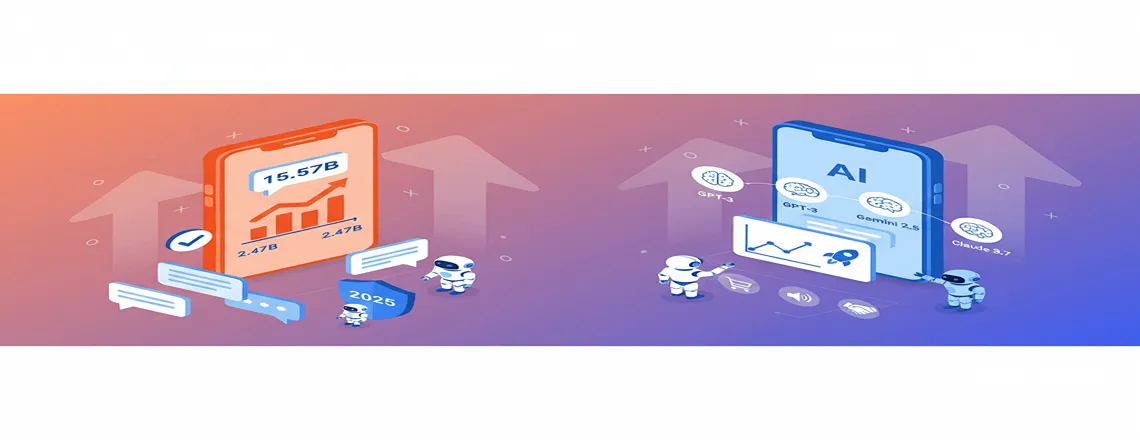
The global chatbot market is projected to reach $15.57 billion in 2025, up from $2.47 billion in 2021, reflecting a significant increase of over $13.1 billion in just three years. This growth is driven by enterprise adoption of AI digital assistants, powered by advanced large language models (LLMs) like GPT-3, Gemini 2.5, and Claude 3.7. These models enhance operational efficiency, scale personalized interactions, and support marketing automation with chatbots, enabling enterprises to improve customer satisfaction and ROI.
Key Features
- chatbot market growth insights
- AI-powered customer engagement and ROI analysis
- Top chatbots and their features in 2025
- Usage patterns, satisfaction, and future trends
- Challenges and enterprise implementation tips
Global Chatbot Survey Statistics 2025 and Market Trends
The global chatbot market is growing at an unprecedented pace. By the end of 2025, it is projected to surpass $15 billion, with the U.S. leading in innovation and adoption.
Table of Global Market Size
| Region | Market Share (2025) | Key Drivers |
| North America | 30.72% | AI innovation, enterprise spending |
| Asia-Pacific | 28.45% | Fast adoption, e-commerce growth |
| Europe | 25.34% | Regulation-driven steady adoption |
| Rest of the World | 14.55% | Emerging digital transformation |
North America dominates due to high enterprise investment, the ability to scale AI-powered customer engagement without massive labor costs, and innovations in autonomous AI agents.
Chatbot Survey Statistics 2025: Adoption Across Key Sectors
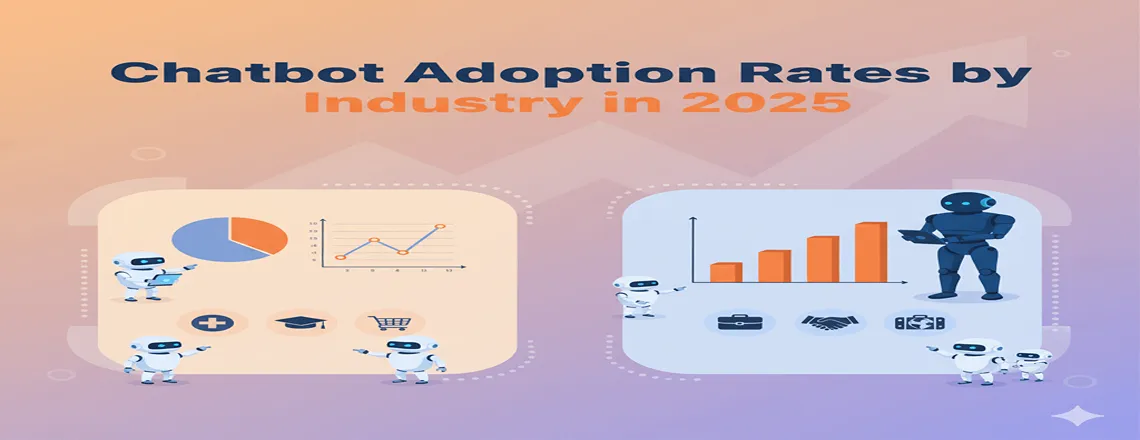
As of 2025, AI-powered chatbot adoption spans multiple industries in the U.S., transforming operations, customer support, and engagement. Enterprise adoption is strongest in sectors where high-volume interactions and customer personalization are critical.
See how Chatboq can automate your enterprise workflows while reducing costs. Start Free Trial.
- Banking: Around 35% of U.S. adults are expected to use AI-enabled banking bots by late 2026. Banks leverage chatbots for tasks like balance inquiries, transaction alerts, fraud detection, and personalized financial guidance. Chatbots reduce call center loads, improving response times and customer satisfaction.
- Retail and E-commerce: Retailers integrate chatbots for marketing automation, product recommendations, and instant customer support, resulting in higher conversion rates. Approximately 28% of enterprises report measurable ROI gains from chatbots in online retail by 2025. Bots analyze browsing behavior and purchase history to deliver tailored recommendations.
- Healthcare: Hospitals and clinics increasingly deploy virtual assistants like Siri, Alexa, and Google Assistant to manage patient queries, appointment scheduling, and follow-up reminders. AI chatbots reduce administrative workload by 36.8%, enabling healthcare staff to focus on clinical care.
- Customer Service And Call Centers: Autonomous AI agents now handle repetitive queries, freeing human agents for complex issues. Enterprises report up to 30% reduction in human workload, demonstrating cost savings and operational efficiency.
- Education: Universities and online learning platforms implement chatbots to assist with admissions, enrollment, scheduling, and student support. These digital assistants provide instant answers, improving student engagement and operational efficiency.
Customer Usage Patterns and Behavioral Insights
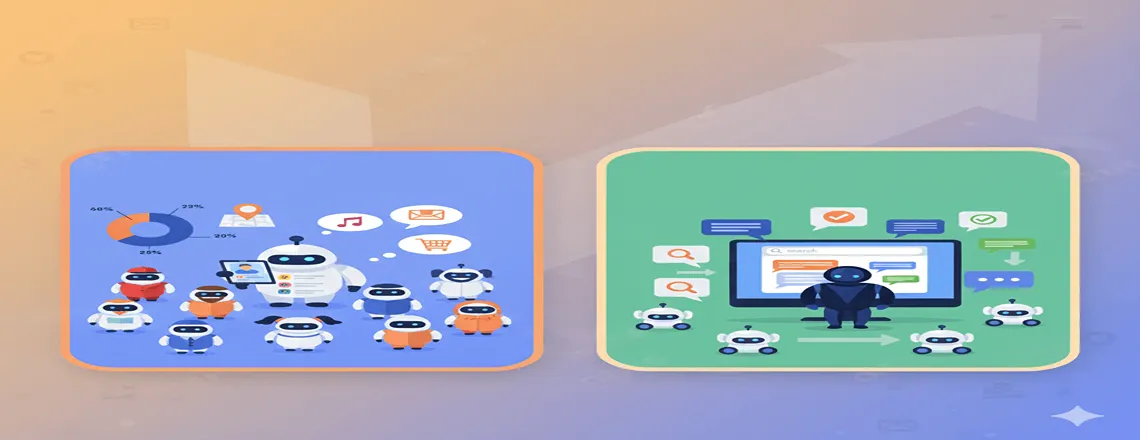
Consumers increasingly interact with chatbots daily, often without realizing it. Many prefer chat-based search engines over traditional search tools for faster, concise answers. Platforms like Perplexity and Arc Search illustrate how web search integration in chatbots is reshaping user behavior.
Demographics and Preferences
Consumer behavior shows that younger demographics (18–35) prefer instant assistance and personalized chatbot interactions. They expect bots to demonstrate empathy, speed, and contextual understanding.
Behavioral Shifts Toward Chat-Based Search
Platforms like Perplexity and Arc Search show the rise of chat-based search engines, where users ask questions conversationally instead of typing keywords. Over 60% of Gen Z and Millennials prefer digital interactions over phone calls, making AI-powered customer engagement essential for brands.
ROI, Cost Reduction, and Financial Impact of Chatbots
Chatbots deliver tangible business benefits. U.S. companies report billions in savings using AI digital assistants in business to automate customer support, sales, and marketing tasks. Enterprise chatbot software reduces staffing costs and improves response times, delivering measurable ROI.
Retailers, banks, and healthcare providers see higher conversion rates through customer experience automation. A single bot can handle thousands of queries while maintaining quality through knowledge base integration and contextual response generation.
| Industry | Avg. Cost Reduction (2025) | ROI Gains (%) |
| Banking | 25% | 38% |
| Healthcaer | 30% | 35% |
| Retail And E-commerce | 28% | 42% |
Case Studies: Banking, Retail, and Healthcare
Banking: Reduced fraud detection costs with AI bots.
Retail: Personalized shopping assistants increased cart size.
Healthcare: Appointment scheduling bots freed staff for care delivery.
Experience these savings firsthand. Book a free Chatboq demo to see how your enterprise can cut costs and improve AI-powered customer engagement.
Chatbot Survey Statistics: Most Popular Chatbots in 2025
In 2025, the chatbot landscape is highly competitive, with several AI-powered customer engagement platforms leading the market. These chatbots are transforming customer experience automation, helping businesses engage users more effectively. Below is a detailed ranking of the most popular chatbots and their unique features:
1. Chatboq
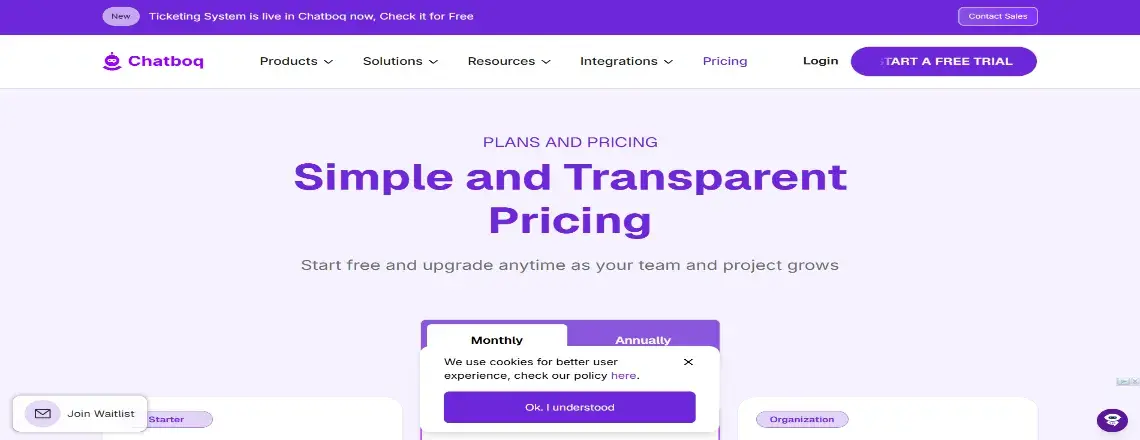
Chatboq emerges as a comprehensive enterprise-grade chatbot platform. Unlike other tools, it offers full CRM integration, marketing automation with chatbots, and omnichannel support across websites, messaging apps, and social media. With contextual response generation, knowledge base integration, and AI-powered personalization, Chatboq ensures higher engagement, measurable ROI, and scalable human-like conversations. Enterprises adopting Chatboq benefit from continuous customer service, smarter AI responses, and tailored digital experiences, making it a standout in the competitive 2025 market.
2. ChatGPT
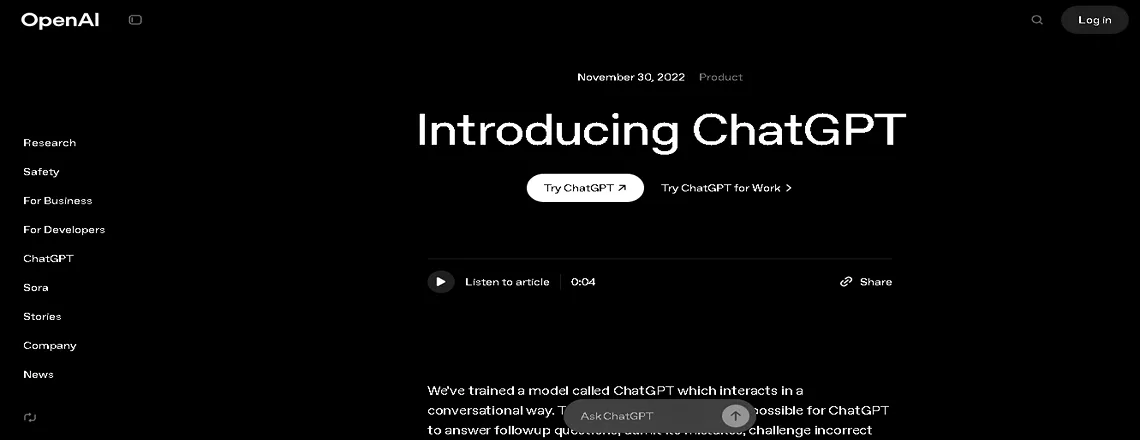
ChatGPT remains the market leader with over 300 million weekly users. Powered by generative pre-trained transformer (GPT) models, it excels in human-like conversations online, making it ideal for customer support, content generation, and personalized interactions. Its deep learning capabilities allow it to understand intent, recognize patterns in text, and deliver accurate contextual responses.
3. Google Gemini
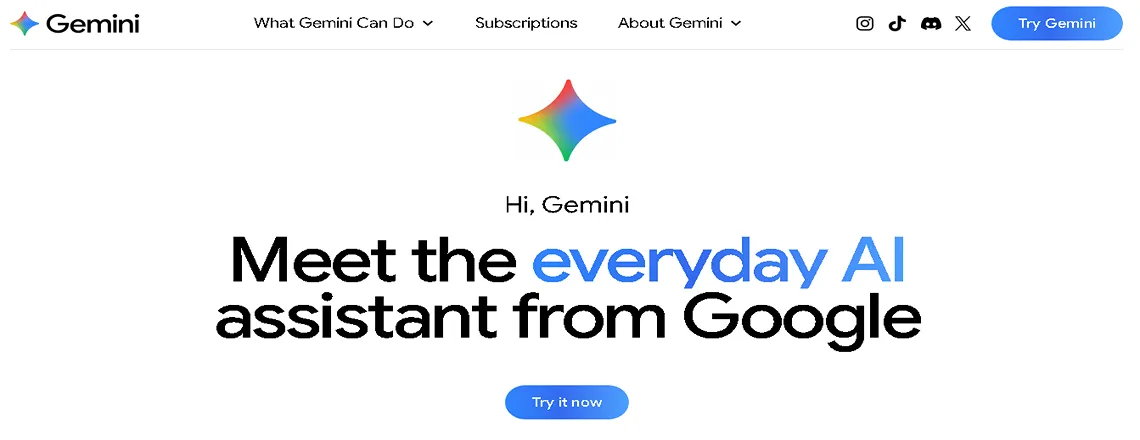
Google’s Gemini focuses on multimodal AI, allowing it to process text, audio, images, and video in real time. Enterprises use it for advanced analytics, chat-based search engines, and AI-powered digital assistants in business. Gemini integrates well with Google Workspace, making it suitable for marketing automation with chatbots and internal operations.
4. Anthropic Claude

Claude specializes in safe and ethical AI interactions, prioritizing bias and fairness in AI models. It’s widely used for customer support, compliance monitoring, and generating human-like conversational experiences while minimizing the risk of AI hallucinations (false answers). Its advanced reasoning model ensures accuracy in high-stakes environments.
5. Microsoft Copilot
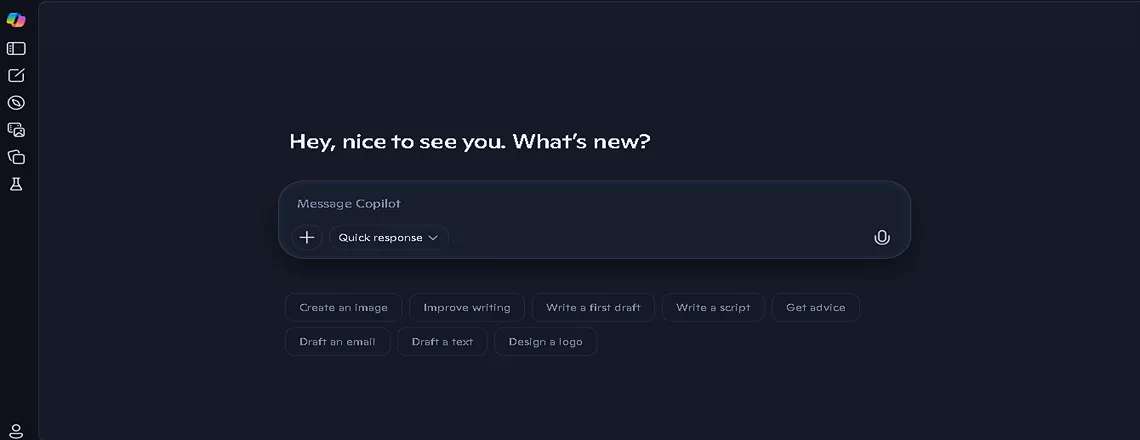
Copilot integrates deeply with Microsoft 365 applications, offering productivity automation for enterprises. Its strength lies in AI digital assistants in business, performing tasks like email management, customer query handling, and reporting. With contextual response generation, it enhances both employee efficiency and customer engagement.
6. DeepSeek
Emerging players like DeepSeek focus on specialized AI applications for e-commerce and digital marketing. Its key features include intent recognition, sentiment analysis, and personalized chatbot interactions that increase conversions and user engagement. While smaller, it is rapidly gaining traction due to its innovative approach and affordability.
Comparison Table: Top Chatbot Survey Statistics in 2025
| Chatbot | Key Feature | Best Use Case | Enterprise Suitability |
| Chatboq | CRM integration, omnichannel, personalized AI | Enterprise customer engagement, ROI | High |
| ChatGPT | GPT-based, human-like conversations | Customer support, content generation | High |
| Google Gemini | Multimodal AI (text, audio, video, images) | Analytics, internal operations | High |
| Anthropic Claude | Ethical AI, bias & fairness control | Compliance, secure support | Medium-High |
| Microsoft Copilot | Productivity automation in Microsoft 365 | Workflow automation, employee support | High |
| DeepSeek | Intent recognition, sentiment analysis | E-commerce, marketing automation | Medium |
Chatbot Performance Metrics: Engagement and Retention
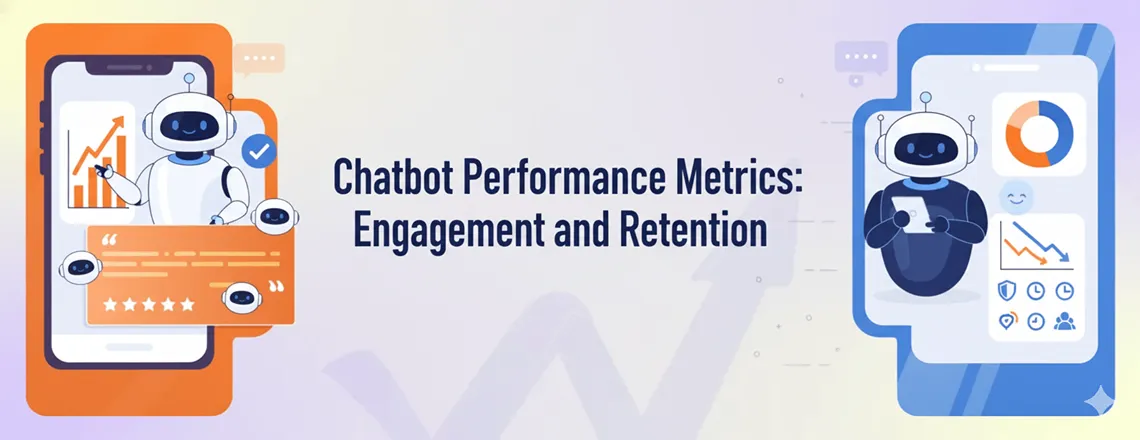
Performance is key for enterprise adoption. Companies track chatbot performance metrics like session length, resolution rates, and user retention. Advanced platforms see customers engage 6–8 minutes per session on average.
Retention improves further with human-AI interaction design. Reports show bots with intelligent design retain 40% more users, proving that customer satisfaction benchmarks rely on speed, accuracy, and personalization. Platforms that integrate intent recognition and sentiment analysis outperform competitors consistently.
Customer Satisfaction and Trust in AI Chatbots
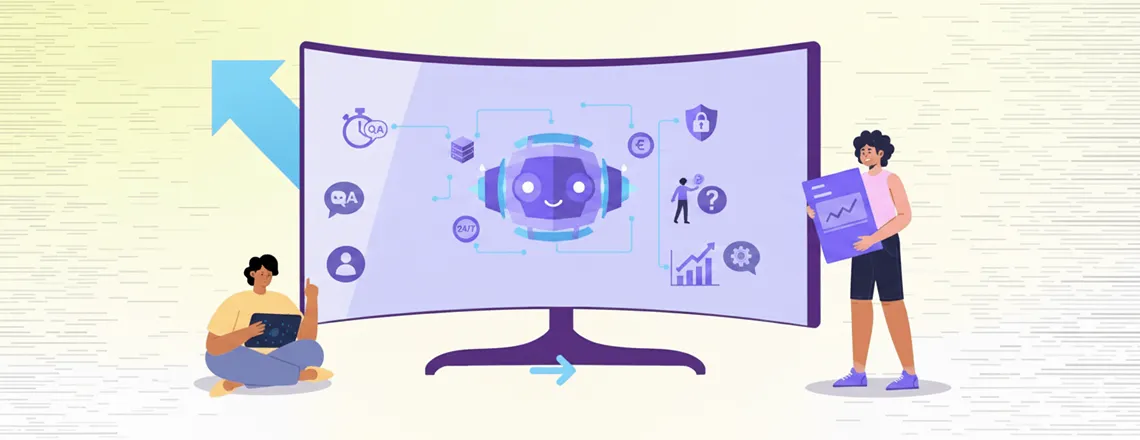
Trust is critical. U.S. consumers value speed and personalized chatbot interactions, but many worry about accuracy. Risks like AI hallucinations (false answers) and bias and fairness in AI models can affect trust.
Companies mitigate risks using monitoring, audits, and strict privacy protocols. Platforms that integrate knowledge base integration and contextual response generation maintain trust while improving customer satisfaction benchmarks. Chatboq’s compliance and enterprise-level security ensure businesses can deploy AI assistants confidently.
Advanced Capabilities Driving Chatbot Growth
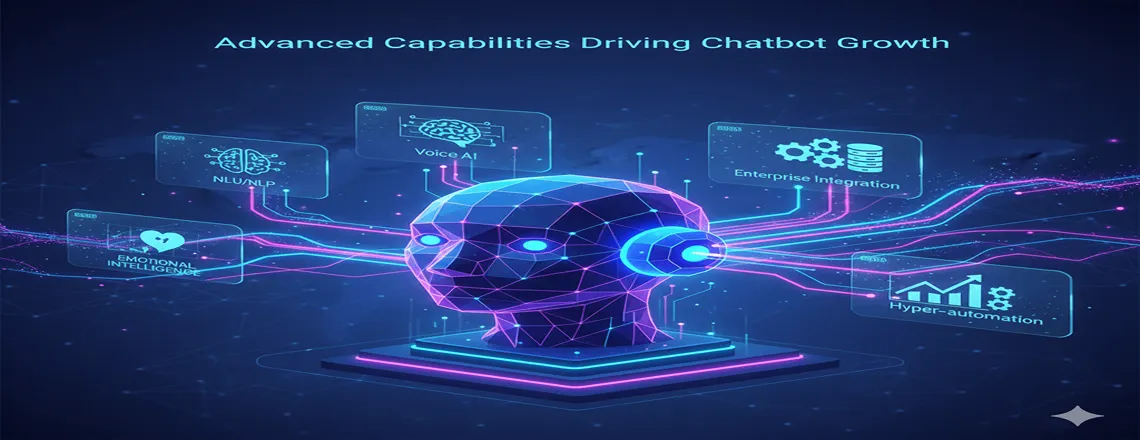
Generative AI in chatbots now enables multi-format processing via multimodal AI. Chatbots can summarize video content, analyze images, or respond to audio queries, enhancing engagement and efficiency.
Integration with IoT and AI-powered digital twins allows digital replicas of employees to interact 24/7. Enterprises benefit from continuous service, while consumers enjoy personalized chatbot interactions that feel natural, scalable, and highly responsive.
Future Trends and Predictions Beyond 2025
The AI market is set for explosive growth after 2025. Global AI agent revenue is projected to rise from $5.32 billion in 2025 to nearly $42.7 billion by 2030 with a 41% CAGR. In the U.S., the market may grow at a 43% CAGR, reaching billions in value, while Asia-Pacific could hit $14.1 billion by 2030.
Agentic AI is also expanding, forecasted to reach $42.5 billion by 2030. Meanwhile, the digital twin market could surpass $143 billion by 2030. These numbers show that autonomous AI agents, personalized chatbot interactions, and digital customer service tools will shape the next era of enterprise communication.
Growth Projections Beyond 2025
| Technology / Market | 2025 Value | 2030 Value | CAGR (2025–2030) |
| AI Agent Revenue | $5.3B | $42.7B | 41% |
| U.S. AI Market | — | Billions (43% CAGR) | 43% |
| Asia-Pacific AI Market | —- | $14.1B | ~40% |
| Digital Twin Market | 21.14B | 149.81B | 47.9% |
Implementation Challenges and Barriers to Success
Adoption challenges include data privacy in AI systems, with regulations like CCPA and GDPR shaping deployments. Training advanced LLMs requires significant compute resources, limiting smaller businesses.
Enterprises need secure, scalable SaaS chatbot solutions like Chatboq, ensuring automation without compromising compliance, security, or performance. With Chatboq, businesses can overcome barriers while maximizing ROI and efficiency.
Key Takeaways and Conclusion
The chatbot market is booming. AI chatbot survey statistics 2025 show adoption across industries, improved customer satisfaction benchmarks, and measurable ROI through AI-powered customer engagement.
Challenges remain, including chatbot limitations and risks, and privacy concerns. But with platforms like Chatboq, businesses can deploy enterprise-grade chatbot solutions, achieve personalized chatbot interactions, and gain a competitive advantage.
The future is now.
Start your free Chatboq trial today and transform customer experience with AI-driven automation.
Frequently Asked Questions (FAQs)
Chatbot survey statistics 2025 show adoption trends, ROI, and usage patterns across U.S. industries, highlighting the growing reliance on AI-powered customer engagement.
Banking, retail, healthcare, and education lead adoption, using digital customer service tools and virtual assistants like Siri, Alexa, and Google Assistant.
Chatbots reduce staffing costs, automate repetitive queries, and provide personalized interactions, driving measurable ROI and improving customer satisfaction benchmarks.
Leading platforms include ChatGPT, Google Gemini, Anthropic Claude, Microsoft Copilot, and DeepSeek, offering features like multimodal AI, deep research, and personalized interactions.
Many use chat-based search engines, e-commerce support, and virtual assistants, preferring fast, human-like conversations powered by intent recognition and sentiment analysis.
Challenges include data privacy in AI systems, the cost of training large language models (LLMs), and ensuring accurate, unbiased responses in enterprise environments.
By offering personalized chatbot interactions, quick responses, and context-aware communication, chatbots enhance trust and improve overall customer satisfaction.
Generative AI, multimodal AI, AI-powered digital twins, and autonomous AI agents allow chatbots to interact across formats, automate tasks, and deliver continuous engagement.
Chatbots will expand in government, law, and education, with smarter contextual response generation, AI agents automating workflows, and deeper personalization.
Chatboq provides scalable SaaS solutions with CRM integration, marketing automation with chatbots, omnichannel support, and personalized AI-driven interactions for measurable ROI.

Daniel Wong
Technical Content Writer
My name is Daniel Wong, a Technical Content Writer from Singapore with a strong interest in AI-powered tools and digital automation. At ChatBoq AI, I focus on creating practical and easy-to-follow content that helps businesses and individuals understand how chatbots work and how to use them effectively.
I enjoy breaking down complex topics like natural language processing (NLP) and conversational AI into simple guides that anyone can follow. Each article is based on careful research, real-world examples, and testing to ensure accuracy and reliability.
Through ChatBoq AI, my goal is to provide readers with trustworthy insights, step-by-step tutorials, and the latest trends in chatbot technology.
✍️
Expert in AI & Chatbot Technology

Leave A Comment