
A 2025 Guide For Mastering Chatbot Marketing
If you’re looking to master chatbot marketing, you’re essentially learning how to use automated conversation tools that engage your customers, bring in leads, and boost sales through digital channels. Chatbot marketing is a marketing strategy that uses conversational AI to streamline your marketing efforts and guide customers through their buying journey. Throughout this guide, I’ll walk you through implementing effective chatbot marketing strategies that work in 2025, everything from picking your chatbot platform to tracking your return on investment. No matter if this is your first chatbot for marketing or you’re refining current systems, you’ll find actionable techniques that produce real, measurable outcomes.
📑 Table of Contents
- A 2025 Guide For Mastering Chatbot Marketing
- Key Highlights
- What is Chatbot Marketing?
- Why Businesses Need Chatbot Marketing Now
- Core Benefits of Chatbot Marketing
- Types of Marketing Chatbots You Should Know
- Building Your Chatbot Marketing Strategy
- Chatbot Marketing Best Practices That Drive Results
- Common Chatbot Marketing Mistakes to Avoid
- Real Success Stories in Chatbot Marketing
- Choosing the Right Chatbot Solution
- Measuring Your Chatbot Marketing Performance
- Future Trends in Chatbot Marketing
- Conclusion – Your Chatbot Marketing Action Plan
- Frequently Asked Questions (FAQs)
Key Highlights
| Learn effective chatbot marketing strategies for 2025 Discover AI-powered tools for business growth Boost engagement and lead conversion with chatbots Automate marketing while enhancing customer experience Measure ROI and future-proof your marketing efforts |
What is Chatbot Marketing?
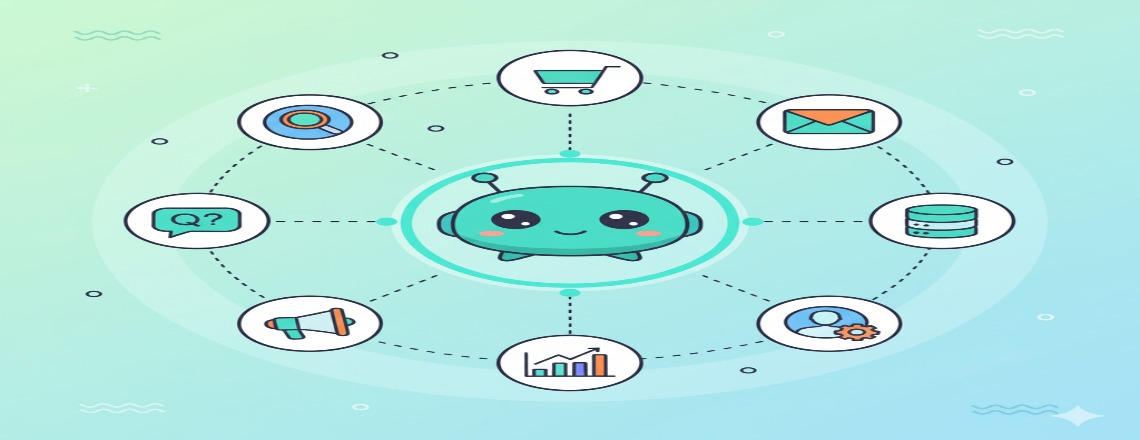
Chatbot marketing uses automated conversational software that talks with your potential and current customers through digital channels. These smart assistants interact with site visitors, respond to their questions, suggest products they might like, qualify leads, and guide users through your sales process, and they do all this without anyone from your marketing team being involved.
Today’s marketing bots work on your website, social media channels, including Facebook Messenger and WhatsApp, plus mobile applications. They mix pre-written responses with artificial intelligence so they can figure out what customers want and give them the right information exactly when they need it.
Traditional marketing channels just push messages out. Using conversational marketing creates actual two-way conversations. This back-and-forth approach comes across as more personal and keeps people interested, which means you’ll see better conversion rates than you’d get from static forms or generic email marketing campaigns.
The chatbot technology has come a long way. Modern chatbots don’t just answer FAQs; they sort leads by asking smart questions, suggest products matching what users like, book appointments, handle orders, and even deal with customer complaints before passing complicated stuff to your human team members.
Why Businesses Need Chatbot Marketing Now
How consumers behave has completely changed. Your customers now expect quick responses, recommendations made just for them, and smooth experiences no matter where they interact with you. Old-school marketing and customer service approaches can’t keep up with what people expect unless you throw massive resources at the problem.
How fast you respond directly affects whether people buy. Research tells us 82% of consumers want immediate answers when they have sales questions. If your business takes hours getting back to people, those potential customers have already gone to your competitors. When you use chatbots, they get back to people in seconds, capturing interest right when they’re most interested in buying.
Growth in the chatbot market shows this is real. Businesses get that automation isn’t replacing human connection, like it’s about making personalized engagement possible at scale. One conversational marketing chatbot handles thousands of conversations happening at the same time, and each conversation gets customized for that specific user’s needs and what they like.
Younger people especially like messaging better than phone calls or emails. Companies that ignore this change risk becoming irrelevant to emerging customer groups who’ll drive future revenue. Using chatbots for marketing reaches customers right where they’re already hanging out in messaging apps and on social platforms.
The competitive situation has shifted, too. As more businesses adopt this technology, companies without these marketing tools find themselves at a disadvantage. Prospects who compare their options definitely notice when one company gives instant, useful responses while another makes them wait around for email replies.
Core Benefits of Chatbot Marketing
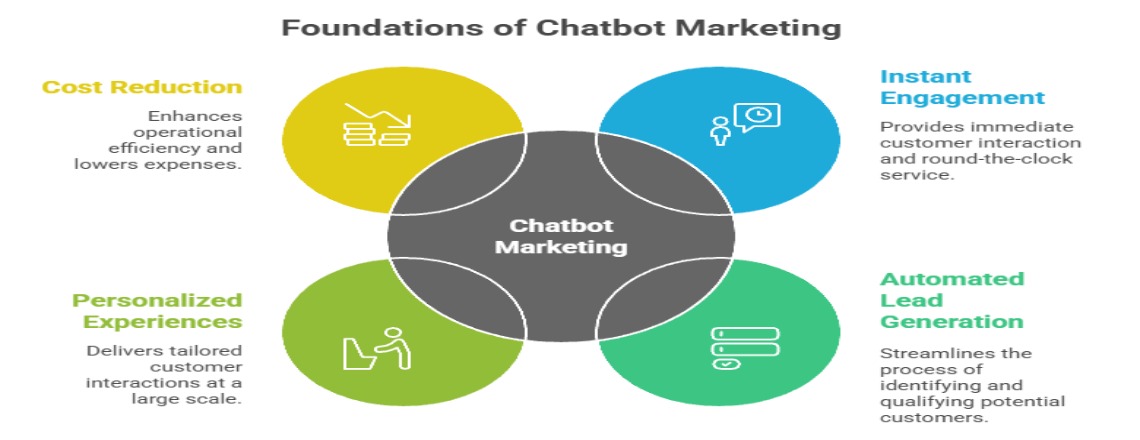
Instant Customer Engagement and 24/7 Availability
Your marketing chatbots don’t need sleep. They talk with website visitors at 3 AM just as enthusiastically as they do at noon, grabbing leads and answering questions no matter what timezone or business hours you’re dealing with. This round-the-clock availability has a direct impact on your bottom line.
Think about what normally happens on websites. People browse through products, read your content, and lots of times they leave with questions that nobody answered. A chatbot on your website jumps in to help at key moments when users look at pricing pages, seem like they’re about to leave, or spend time checking out specific products. This well-timed help can make the difference between someone buying or bailing.
How fast you respond matters a lot. Studies show companies that respond to leads within five minutes have 100 times better odds of connecting with them and qualifying them compared to companies that wait 30 minutes. Chatbots in marketing get rid of response delays completely.
Automated Lead Generation and Qualification
Old-fashioned lead capture depends on forms that users quit filling out all the time. Chatbots completely change this through conversational lead generation. By naturally asking questions throughout a conversation, they collect contact info and qualifying details without making it feel like an interrogation.
The qualification happens automatically. A chatbot uses a chatbot system that asks about budget, timeline, specific needs, and who makes decisions, questions that feel pushy in static forms but work naturally in conversations. This information helps your sales and marketing teams focus on the prospects worth their time and increase sales.
Quality goes up along with quantity. Since chatbots can ask detailed qualifying questions, your teams get warmer, better-qualified leads. This cuts down on time wasted with prospects who aren’t a good fit and pushes conversion rates up throughout your funnel.
Personalized Customer Experiences at Scale
Modern AI-powered chatbots look at how users behave, what they’ve browsed, and past interactions to create customized experiences. They recall previous conversations, bring up past purchases, and adjust recommendations based on what preferences people have shown.
This personalization covers the whole customer journey. A visitor coming back gets product suggestions based on what they browsed before. A customer with a support question gets recognized right away, with the chatbot pulling up their account details and order history. This context-aware chatbot experience feels surprisingly personal, even though it’s automated.
The scale advantage is huge. While a human sales rep deals with one conversation at a time, a conversational marketing chatbot juggles thousands at once, and each one stays personalized and relevant to that particular user.
Reduced Costs and Increased Efficiency
Research from IBM shows that implementing a chatbot usually cuts customer service costs by 30%. One bot deals with inquiries that would otherwise need multiple full-time employees, which frees up your human agents to handle complex issues that need empathy and careful judgment.
Your return on investment builds over time. What you spend on initial development gets offset by continuous savings in support staff, faster response times that lead to more conversions, and better customer retention from improved experiences.
Marketing chatbots create valuable data too. Every conversation shows you customer pain points, common objections, questions people ask frequently, and what motivates them to buy. This intelligence flows back into how you develop products, craft marketing messages, and plan sales strategies.
Types of Marketing Chatbots You Should Know
Rule-Based Chatbots
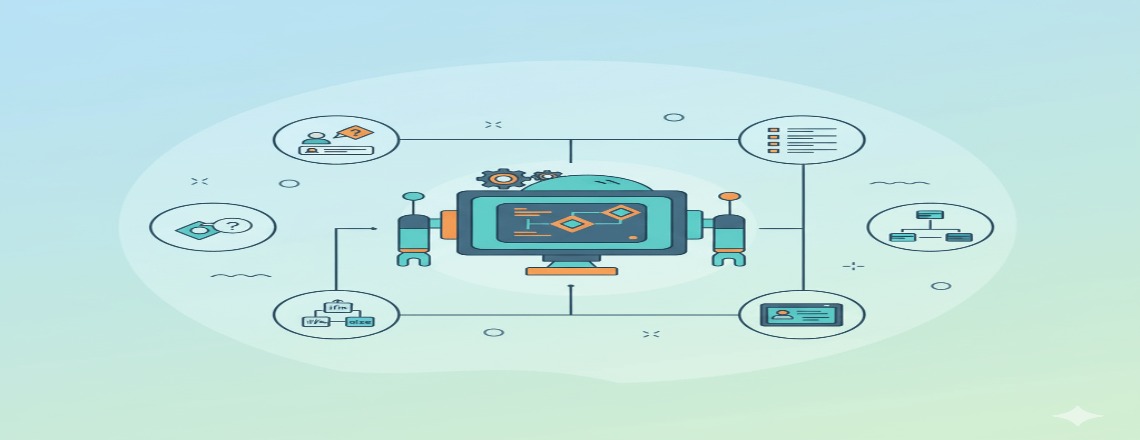
Rule-based systems stick to predetermined conversation paths using decision trees. Users pick from menu options or buttons, and the chatbot gives back pre-written answers. These types of chatbots handle straightforward tasks well, like scheduling appointments, tracking orders, or pointing users toward specific resources.
Though they’re simpler than AI alternatives, rule-based chatbots still bring value for scenarios where you need consistent, predictable responses. They’re easier to build and keep running, which makes them great starting points for businesses just getting into chatbot marketing.
The limitations show up with complex queries. Rule-based bots can’t figure out variations in how people phrase things or deal with unexpected questions. Users have to stick to the prescribed conversation flow, which feels limiting if what they need doesn’t match the available options.
AI-Powered Conversational Chatbots

These advanced systems use AI and natural language processing (NLP) so they understand what users want, no matter how they phrase their questions. They pick up on context, handle complicated queries, and have dynamic conversations that feel surprisingly human.
Machine learning makes continuous improvement possible. AI chatbots spot patterns in successful interactions and improve their chatbot responses over time. They learn from every single conversation, getting more accurate and helpful as they’re used more.
Integration capabilities make the difference between good AI chatbots and great ones. When they’re connected to customer relationship management systems, marketing automation platforms, and product databases, these chatbots can access thorough information to give truly personalized help.
The investment costs more, but the results are better too. AI-powered conversational marketing chatbots tackle more complex scenarios, cut down on frustration from rigid conversation flows, and create experiences that genuinely make users happy.
Building Your Chatbot Marketing Strategy
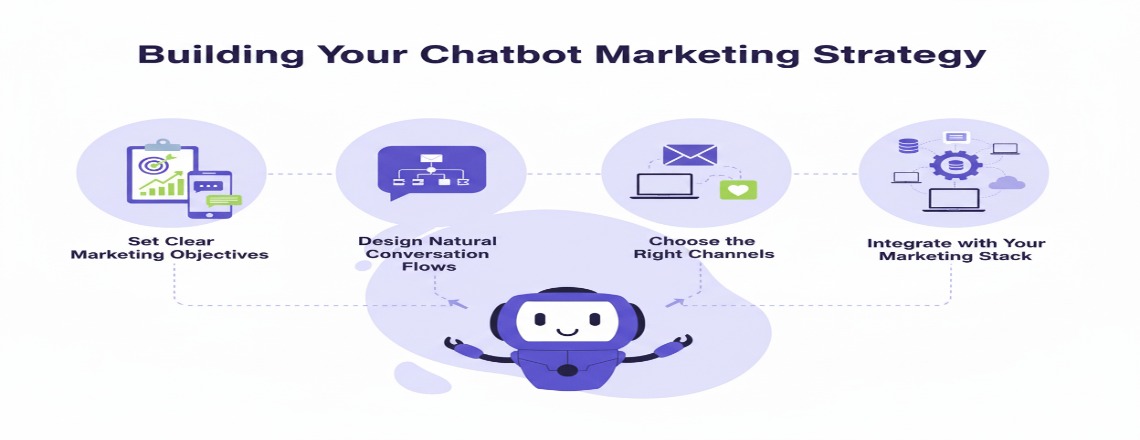
Set Clear Marketing Objectives
An effective chatbot marketing strategy starts with specific marketing goals. Define what success looks like before you build anything. Common objectives include cutting customer support ticket volume by automatically handling routine questions, increasing how many of leads you capture by making engagement easier than traditional forms, improving conversion rates by answering sales questions at crucial decision moments, and boosting customer satisfaction through faster response times and round-the-clock availability.
Different goals need different chatbot designs. A lead generation bot asks qualifying questions and grabs contact information. A support bot taps into knowledge bases to answer product questions. A sales bot recommends products and handles objections to increase sales.
Measure baseline metrics before you launch. If your marketing goals involve reducing support tickets, count your current ticket volume and average response times. This baseline lets you prove ROI after you implement.
Design Natural Conversation Flows
When you create a chatbot, write bot scripts using natural language that matches your brand voice. Avoid corporate jargon or overly formal phrasing unless that fits your brand identity. An effective chatbot sounds like a helpful colleague, not a robot reading from scripts.
Map out typical user journeys before you build conversation flows. What questions do prospects ask? What information do they need at different stages? What objections come up during sales conversations? Make your chatbot address these actual needs instead of what you assume people need.
Build in personality where it fits. Humor, empathy, and friendly tones make interactions memorable. A chatbot with personality builds emotional connections that straight information delivery can’t achieve.
Always give clear paths to human agents. Users should never feel stuck in unhelpful bot loops. Make handoff obvious and easy phrases like “Would you like me to connect you with a specialist?” give users control over what happens.
Choose the Right Channels
Put your chatbot where your customers already hang out. Website chatbots grab visitors at high-intent moments. A Facebook Messenger chatbot or messenger chatbot engages social media audiences right where they’re already active. WhatsApp bots give you direct communication channels for customer service.
Each platform has its own characteristics. Messenger allows rich media like image carousels and quick reply buttons. Website bots can trigger based on specific visitor behaviors. WhatsApp’s popularity in international markets makes it essential for global businesses.
Don’t spread yourself too thin at first. Master one channel before you expand. One highly effective website chatbot delivers better results than mediocre implementations across multiple platforms.
Integrate with Your Marketing Stack
Standalone chatbots bring limited value to your overall marketing. Integration with customer relationship management systems, email platforms, and analytics tools builds comprehensive customer views and enables sophisticated marketing automation.
When your marketing chatbot connects to your CRM, it recognizes returning customers, brings up previous purchases, and gives contextually relevant help. Conversation data that flows back into CRM systems makes sure all teams can access complete customer interaction histories.
Marketing automation integration lets chatbots trigger email sequences, update lead scores, and segment contacts based on how conversations turn out. A prospect who asks about pricing but doesn’t convert might automatically go into a nurture campaign that addresses common objections.
Analytics integration tracks which conversations lead to conversions, which messages work most effectively, and where users get frustrated and abandon conversations. This data drives continuous optimization of your digital marketing strategy.
Chatbot Marketing Best Practices That Drive Results
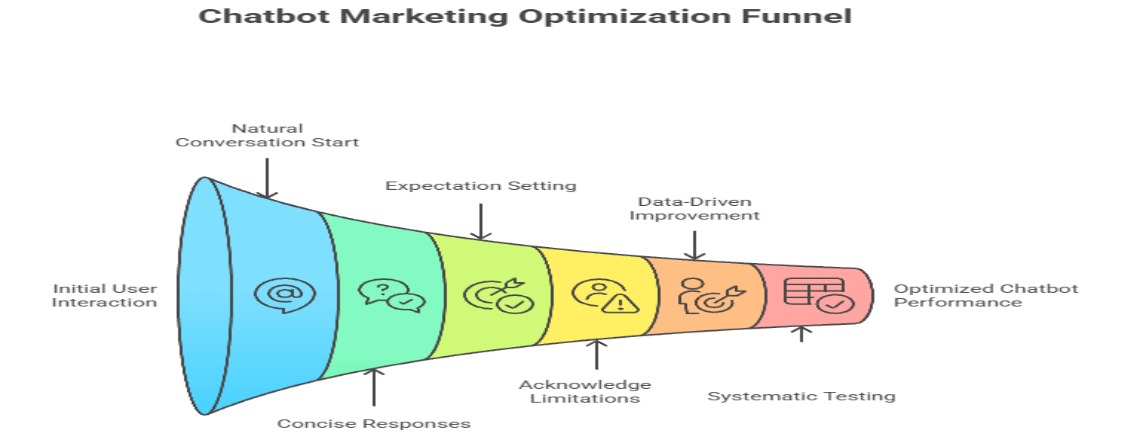
- Start conversations naturally: Stay away from aggressive pop-ups that interrupt the user experience. Instead, present chatbot options subtly so visitors can start contact when they’re ready. Timing matters; greet users after they’ve spent enough time to understand your site but before they show signs of leaving.
- Keep initial responses short: Long paragraphs overwhelm users on small screens. Break information into digestible chunks with clear options for learning more. Use quick reply buttons to guide conversation flow and cut down on typing friction.
- Set expectations right away: Let users know they’re talking with a bot and clearly communicate what it can help with for various marketing purposes. Transparency builds trust. Messages like “I’m a virtual assistant specialized in helping you find the right product” prevent disappointment when complex questions need human intervention.
- Acknowledge when you can’t help: Nothing frustrates users more than bots that pretend to understand when they don’t. Train your chatbot to ensure it recognizes when it’s beyond its capabilities and smoothly transitions to human agents. Phrases like “This question requires specialized expertise. Let me connect you with someone who can help” keep experiences positive.
- Use conversation data for continuous improvement: Review chat logs regularly to spot confusion points, common questions the bot can’t answer, and opportunities to expand what it can do. The best strategies evolve based on real user interactions instead of assumptions for marketing use cases.
- Test different approaches systematically: A/B test greeting messages, conversation flows, and calls-to-action as part of your marketing campaigns. Small wording changes often create significant results. Track metrics like conversation completion rates and user satisfaction to identify winning variations.
- Keep your bot maintained actively: Update responses as products, policies, or offerings change. Outdated information damages trust faster than having no bot at all. Schedule regular reviews to make sure everything stays accurate and the chatbot marketing can help achieve your objectives.
Common Chatbot Marketing Mistakes to Avoid
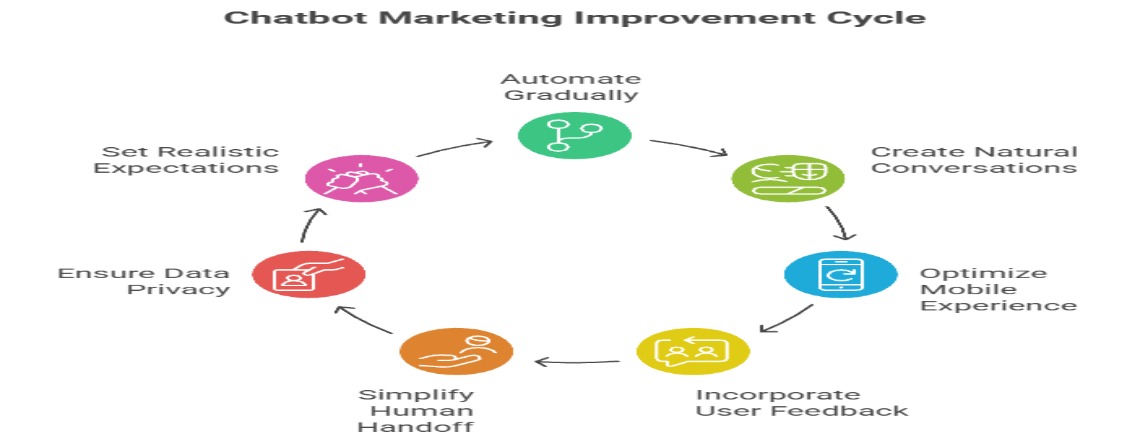
Don’t try automating everything right away
Start with focused marketing use cases where bots do well answering FAQs, scheduling appointments, or giving simple product recommendations. Build complexity gradually as you learn what works.
Creating conversations that feel robotic is a common mistake
Rigid, scripted responses frustrate users. Include variations in phrasing, use contractions, and acknowledge different ways users express the same need. Your conversational marketing chatbot should feel natural, not mechanical.
Neglecting mobile experience hurts results
Most chatbot interactions happen on smartphones. Test extensively on mobile devices to make sure quick reply buttons are easily tappable, text is readable, and images load quickly.
Ignoring user feedback is a critical error
Pay attention to satisfaction scores and conversation abandonment rates. When users consistently get stuck at certain points, redesign those conversation flows to build a chatbot that works better.
Making human handoff difficult backfires quickly
Some businesses hide human contact options, hoping chatbots handle everything. This backfires when users with complex needs can’t get real help. Make escalation paths obvious and smooth.
Overlooking data privacy creates legal risks
Chatbots collect significant personal information. Put clear privacy policies in place explaining what’s collected and how it gets used. Make sure you comply with regulations like GDPR and CCPA. Secure transmit data with encryption.
Setting unrealistic expectations damages trust
Don’t claim your bot can do more than it actually can. Overpromising leads to disappointment and damaged brand perception.
Real Success Stories in Chatbot Marketing
Sephora
Sephora completely changed beauty retail with chatbot marketing examples across Facebook Messenger and their website. Their virtual assistant asks about skin types, beauty preferences, and specific concerns before recommending products. It also gives makeup tutorials and books in-store appointments.
The results impressed even skeptics. Sephora saw an 11% jump in booking conversions through chatbot interactions. Customers who got personalized recommendations from the bot had higher average order values compared to traditional browsing. The bot now handles thousands of daily conversations, which frees up beauty advisors to focus on in-store experiences.
Booking.com
Booking.com processes 1.5 million customer service messages every month. Their chatbot resolves 30% of inquiries without human intervention, covering reservation changes, property information, payment questions, and booking confirmations.
The impact on customer experience was dramatic. Response times dropped from several hours to under one minute. Customer satisfaction scores stayed high despite automated handling because the bot successfully resolved most issues. The implementation let Booking.com scale customer service without proportionally increasing staff.
A chatbot marketing agency helped a mid-sized e-commerce company implement lead qualification bots. Instead of static lead forms on product pages, visitors had brief conversations where the bot asked about budget, timeline, and specific needs.
Lead volume went up 45% because the conversational format felt less intimidating than forms. More importantly, lead quality improved significantly. Sales teams reported that chatbot-generated leads converted 2.3 times more frequently than form leads because better qualification meant they were talking with genuinely interested, well-matched prospects.
Choosing the Right Chatbot Solution
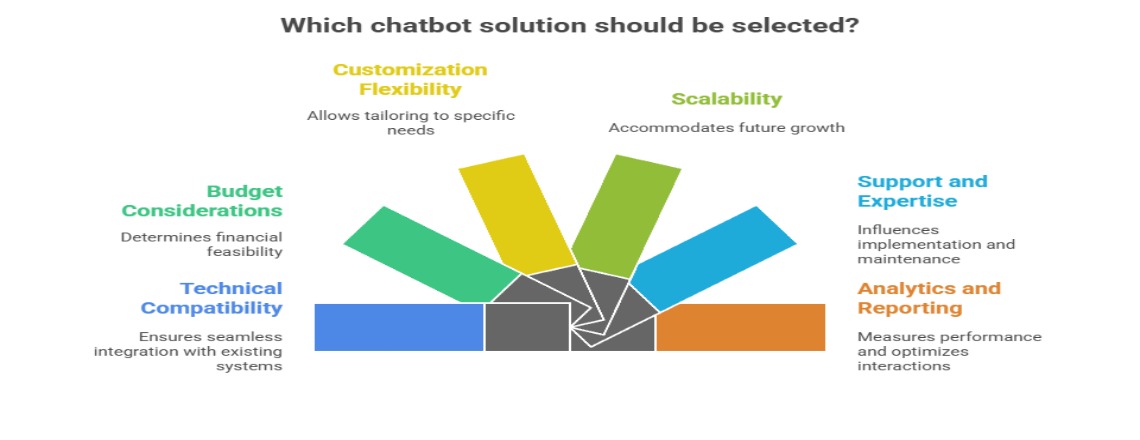
Picking the right chatbot platform significantly impacts success. Consider these factors when you’re evaluating options:
- Technical requirements: Does your use case need rule-based simplicity or AI sophistication? What platforms must the chatbot support: website, Facebook, WhatsApp, or multiple channels? What integrations are essential for your marketing stack?
- Budget considerations: Costs vary dramatically. Simple rule-based bots start under $50 monthly through platforms like ManyChat or Chatfuel. Enterprise AI solutions from companies like Drift or Intercom run thousands monthly. Factor in development time, training data preparation, and ongoing maintenance.
- Customization flexibility: Template-based builders offer quick deployment but limited flexibility. Custom development through a chatbot marketing agency gives complete control but needs more time and resources. Balance speed-to-market with specific business needs.
- Scalability: Pick solutions that grow with your business. Can the platform handle increased conversation volume without performance degradation? Does pricing scale reasonably, or will success become prohibitively expensive?
- Support and expertise: Check vendor support quality. Do they give training, best practice guidance, and responsive technical assistance? If you’re working with a chatbot marketing agency, review their industry experience, technical capabilities, and client testimonials.
- Analytics and reporting: Strong analytics separate good platforms from great ones. You need visibility into conversation flows, drop-off points, user satisfaction, and business impact. Make sure your chosen solution gives actionable insights.
Popular platforms include Dialogflow for AI-powered bots with strong NLP capabilities, ManyChat for user-friendly social media chatbots, Drift for B2B lead generation, Intercom for customer service integration, and HubSpot’s chatbot builder for marketing automation integration.
Don’t commit to annual contracts right away. Test platforms with trial periods or small implementations before expanding. What works brilliantly for one business may frustrate another because of different workflows and customer expectations.
Measuring Your Chatbot Marketing Performance
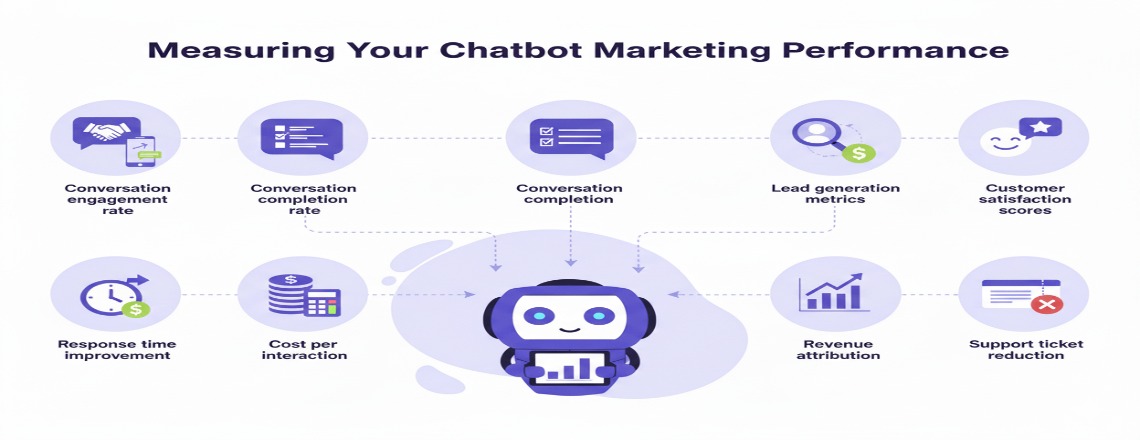
Effective measurement needs tracking multiple indicators that connect chatbot activity to business outcomes:
- Conversation engagement rate: This metric shows what percentage of visitors interact with your chatbot. Low engagement suggests poor placement, weak value proposition, or off-putting messaging. Benchmark across industry standards and optimize greeting messages.
- Conversation completion rate: This tracks what percentage of users finish bot interactions versus abandoning mid-conversation. High abandonment points to usability issues, unhelpful responses, or conversation flows that don’t match user needs.
- Lead generation metrics: Count leads captured through chatbot conversations. Track qualification accuracy by comparing chatbot-qualified leads to sales team assessments. Measure conversion rates from chatbot leads versus other sources to figure out quality.
- Customer satisfaction scores: Deploy post-conversation surveys asking users to rate their experience. Track these scores over time to gauge improvement. Compare chatbot satisfaction to human interaction scores for perspective.
- Response time improvements: Measure average response times before and after chatbot implementation. Faster responses correlate with higher satisfaction and conversion rates. This metric clearly shows chatbot value.
- Cost per interaction: Calculate bot conversation costs versus traditional support channels. Factor in development, maintenance, and operational expenses divided by interaction volume. Most businesses see 60-80% cost reductions per interaction.
- Revenue attribution: Track sales influenced by chatbot interactions. Use UTM parameters and conversion tracking to attribute revenue to conversations that directly led to purchases or pushed prospects through the funnel.
- Support ticket reduction: Count tickets handled by chatbots versus those needing human intervention. Calculate cost savings from reduced ticket volume. This metric resonates strongly with executives evaluating ROI.
Build dashboards visualizing these metrics for quick performance assessment. Regular reporting keeps stakeholders informed and justifies continued investment. Share success stories internally to build organizational support for expansion.
Future Trends in Chatbot Marketing
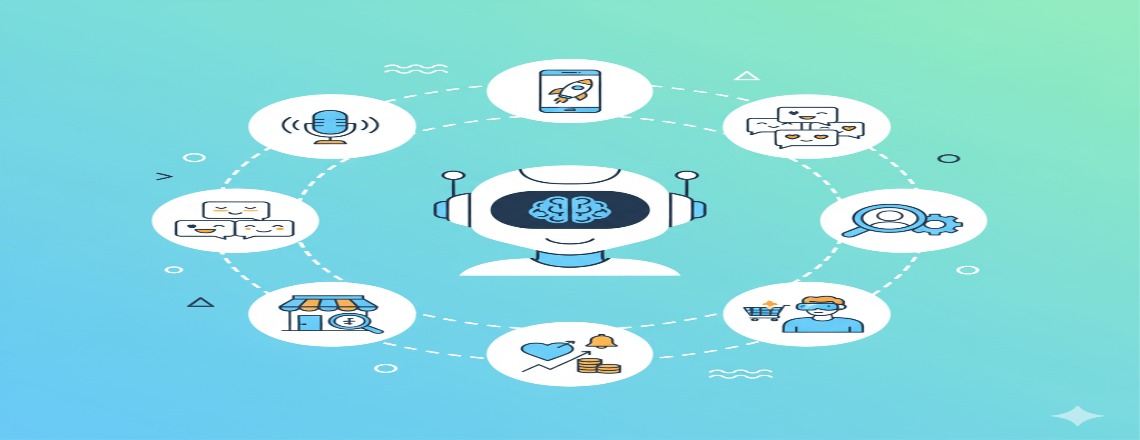
Generative AI represents the next huge leap in chatbot capabilities. Large language models like GPT-4 and Claude understand context at unprecedented levels, generate creative content, and handle complex conversations naturally. Businesses are bringing these technologies in to create chatbots that draft personalized emails, give detailed technical support, and even negotiate basic terms.
The technology lets chatbots move beyond scripted responses into truly intelligent assistance. A generative AI-powered marketing chatbot might write unique product descriptions tailored to specific customer interests or create customized comparison charts addressing particular user concerns.
Predictive analytics will enable proactive engagement. Future chatbots will anticipate what users need before they express it by analyzing past behavior, browsing patterns, time of day, and external factors. Picture a retail bot greeting a returning customer: “Hi, Sarah! Based on your interest in running shoes last month, I wanted to let you know we just restocked that model in your size with a 20% discount today.”
Voice interaction will increasingly complement text-based chatbots. Multimodal interfaces combining voice, text, images, and video create richer experiences. Users might verbally describe a problem while the bot displays visual solutions or video tutorials.
Emotional intelligence is advancing. Next-generation chatbots detect sentiment and adjust responses accordingly. A frustrated customer gets empathetic acknowledgment and faster escalation to human agents. An enthusiastic buyer gets product recommendations matching their energy level.
The chatbot market will keep expanding rapidly. As AI capabilities advance and consumer preferences shift toward conversational interfaces, businesses that master chatbot marketing now will keep a competitive advantage as adoption becomes universal.
Conclusion – Your Chatbot Marketing Action Plan
Mastering chatbot marketing begins with three focused steps: pinpoint one high-value customer interaction to automate, pick a platform that matches your technical capabilities and budget, then launch small and iterate based on real user feedback. Start with simple use cases like handling FAQs or scheduling appointments to build quick wins and organizational momentum. The AI chatbot market share in 2025 shows clear adoption trends. Businesses implementing conversational marketing chatbots now gain competitive advantages that compound over time.
Success means viewing chatbot marketing as an ongoing journey instead of a one-time project. Deploy your first marketing chatbot to a subset of traffic, monitor performance metrics closely, and refine based on conversation data. Whether you build in-house or partner with a chatbot marketing agency, focus on creating genuinely helpful experiences that solve real customer problems. The technology is ready, your customers expect it, and the measurable business results justify the investment.
Frequently Asked Questions (FAQs)
Chatbot marketing uses AI-powered bots to engage customers, generate leads, and boost sales through automated conversations on websites or messaging apps.
It automates conversations using AI, responding to customer queries, recommending products, and guiding users through the buying process.
Customers now expect instant replies and personalization — chatbots deliver both while reducing costs and increasing conversions.
24/7 engagement, higher lead conversion, personalized experiences, reduced operational costs, and improved customer satisfaction.
Mainly rule-based chatbots for simple tasks and AI-powered conversational chatbots for intelligent, context-aware interactions.
Chatbots qualify leads, answer questions instantly, and recommend products — helping convert visitors into paying customers.
Basic chatbots start around $20–$50/month, while advanced AI chatbots for businesses may cost hundreds to thousands monthly.
No. Chatbots assist with repetitive tasks and lead capture but rely on humans for creativity, empathy, and strategic thinking.
Top chatbot marketing platforms include ChatBoq, Drift, Intercom, ManyChat, HubSpot, and Google Dialogflow.
Track engagement rate, leads generated, conversion rate, cost savings, and customer satisfaction improvements.

Daniel Wong
Technical Content Writer
My name is Daniel Wong, a Technical Content Writer from Singapore with a strong interest in AI-powered tools and digital automation. At ChatBoq AI, I focus on creating practical and easy-to-follow content that helps businesses and individuals understand how chatbots work and how to use them effectively.
I enjoy breaking down complex topics like natural language processing (NLP) and conversational AI into simple guides that anyone can follow. Each article is based on careful research, real-world examples, and testing to ensure accuracy and reliability.
Through ChatBoq AI, my goal is to provide readers with trustworthy insights, step-by-step tutorials, and the latest trends in chatbot technology.
✍️
Expert in AI & Chatbot Technology

Leave A Comment