
Exploring the Importance of Chatbot Containment Rate: Complete Guide 2025
It’s a measurement of customer conversations your bot finishes entirely without human assistance. Here’s an example: your chatbot processes 80 conversations out of 100 without needing escalation. You’ve got an 80% containment rate. This chatbot performance metric demonstrates how well your conversational AI supports customers and lightens your support team’s workload at the same time.
📑 Table of Contents
- Exploring the Importance of Chatbot Containment Rate: Complete Guide 2025
- Key Highlights
- Why Chatbot Containment Rate Matters
- Key Benefits of Tracking Containment Rate
- What is Chatbot Containment Rate and How to Calculate It?
- Containment Rate vs Other Key Chatbot Metrics
- How Containment Impacts Other Metrics
- Chatbot Containment Rate Benchmarks Across Industries
- How AI and Machine Learning Improve Chatbot Containment Rate
- Best Practices for Improving Your Containment Rate Chatbot Performance
- Top Tools and Platforms for Tracking Containment Rate
- Common Challenges and How to Address Them
- Using User Feedback to Improve Chatbot Containment Rate
- Success Stories: Companies Winning with High Containment Rates
- Conclusion
- Frequently Asked Questions About Chatbot Containment Rate

In today’s customer service landscape, fast responses available 24/7 aren’t nice-to-have features – they’re mandatory baseline requirements. Why tracking your containment rate chatbot metrics has become so critical: it tells you whether your automation strategy genuinely improves customer satisfaction, cuts operational costs, and boosts service efficiency. Companies that master this benchmark? They’re experiencing higher AI-driven productivity, seriously reduced costs, and much better customer experiences. This evolution has turned chatbot containment rate into the gold standard everyone uses for measuring conversational AI success.
Key Highlights
| Measure chatbot success through containment rate. Boost efficiency and cut support costs. Higher containment equals happier customers. AI and ML improve chatbot performance. Track, optimize, and balance automation quality. |
Why Chatbot Containment Rate Matters
Industry analysts are forecasting the AI chatbot market will balloon to $27.29 billion by 2030. Even more striking: experts predict AI will power 95% of customer interactions by 2025. But here’s the reality: Simply installing a chatbot won’t guarantee success. Whether your automation initiative thrives or crashes depends entirely on how well you execute it.
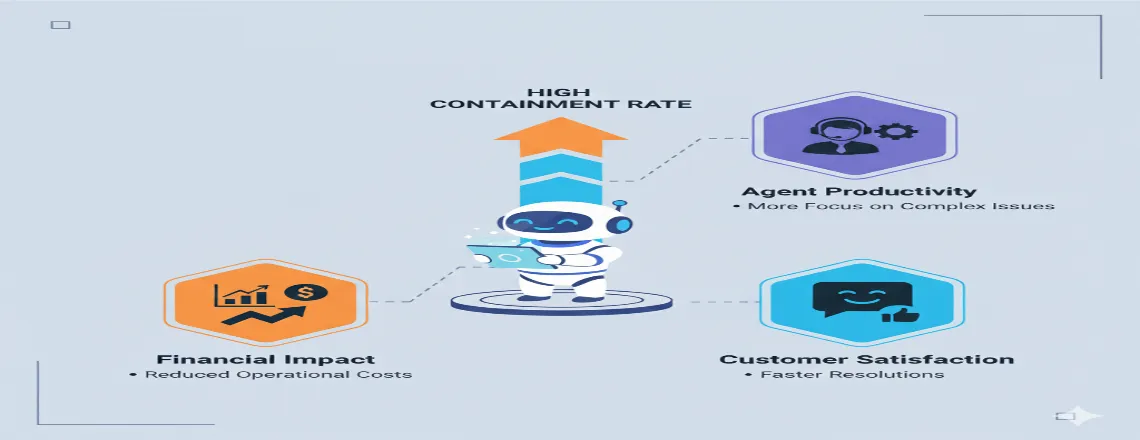
Financial Impact
Each conversation your chatbot successfully contains saves you a lot of cost these days. Companies reaching a high chatbot containment rate benchmark of 70-90% are achieving massive savings. Let me walk you through a realistic scenario. Your company handles 10,000 queries every month, with each one costing $10 to resolve properly. If you increase your containment from 50% to 75%, you’re looking at an extra $360,000 saved annually. That’s not a small change – it’s substantial budget relief that makes a difference.
Customer Satisfaction
There’s a clear connection between high containment rates and satisfied customers. The reason? People get their issues resolved immediately instead of sitting in a queue forever. Research confirms this – consumers actually prefer quick automated responses for simple problems over waiting endlessly for available human agents. The catch? Your bot needs to genuinely solve their problem, not just go through the motions.
Agent Productivity
Strong containment rates liberate your human agents from handling the same questions repeatedly all day long. Instead, they can focus on complicated stuff – problems that demand real empathy, creative thinking, and meaningful problem-solving abilities. This shift reduces burnout significantly, increases job satisfaction, and makes better use of the skilled support staff you’ve spent time recruiting and training.
Key Benefits of Tracking Containment Rate
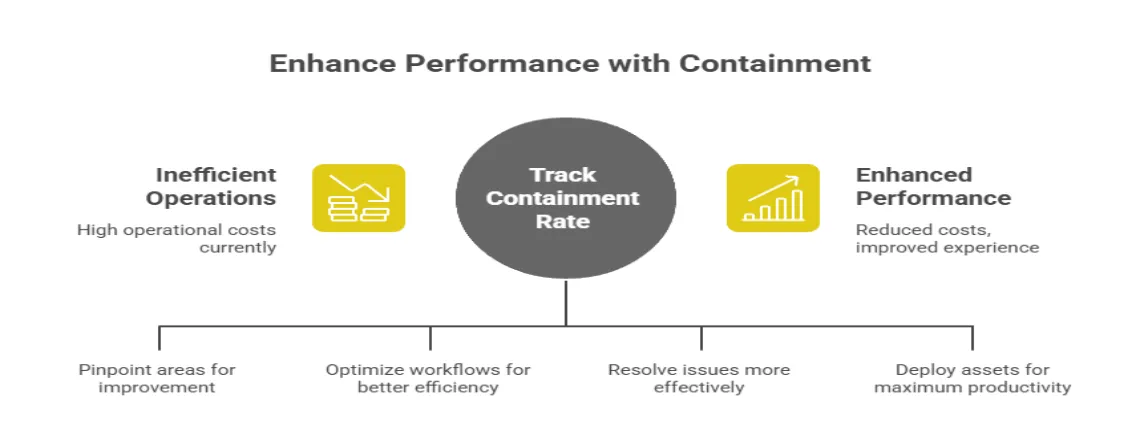
Watching your chatbot containment rate closely gives you three major advantages:
Reduced Operational Costs
The best implementations are saving over $300,000 per year just from smart chatbot deployment. How does this work in practice? Every contained conversation removes human labor costs, cuts training expenses, and lowers infrastructure overhead you’d otherwise pay. When your query volumes increase, automation scales effortlessly without forcing you to hire more staff proportionally.
Improved Customer Experience
Bots respond instantly to all routine tasks – tracking orders, resetting passwords, answering policy questions, and more. They manage unlimited conversations simultaneously without any quality degradation. Available around the clock? That satisfies modern customer expectations without putting strain on your resources.
Better Resource Allocation
Your human agents can move away from boring, repetitive tasks toward handling complex escalations and building real customer relationships. Support teams handle volume surges during holidays or product launches without that frantic search for temporary workers. Plus, the data flowing in from bot interactions improves agent training and enriches your knowledge base in ways manual processes simply cannot.
What is Chatbot Containment Rate and How to Calculate It?
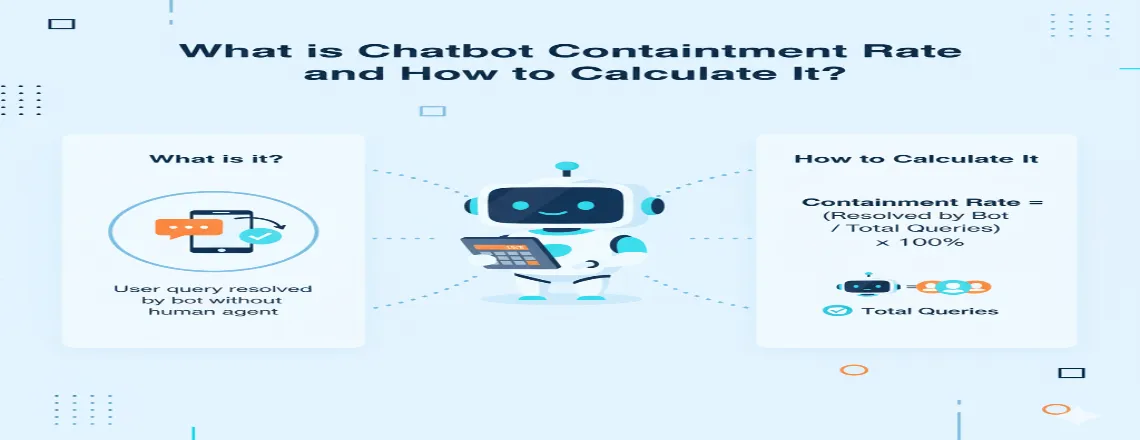
Chatbot containment rate tells you exactly what percentage of customer conversations your bot completes entirely without needing human agent involvement. We’re discussing a genuine end-to-end resolution here that is not just the bot participating somewhere in the chat.
Basic Formula
Containment Rate (%) = (Conversations Fully Resolved by Bot / Total Conversations Initiated) × 100
What Counts as “Fully Resolved”
- Customer got complete information or finished their desired action successfully
- No human agent involvement happened at any point in the conversation
- The customer didn’t immediately reach out again through a different support channel
- The conversation ended naturally without the customer abandoning it
Alternative Method
Some companies calculate this differently: (Total Conversations minus Human Escalations) / Total Conversations × 100. This method basically handles abandoned conversations differently from the first approach. Choose one calculation method and use it consistently for accurate trend tracking.
The important distinction? You’re measuring actual problem resolution, not simply bot participation. If your bot responds but the customer’s problem remains unresolved, that doesn’t count toward your containment rate – regardless of bot involvement.
Containment Rate vs Other Key Chatbot Metrics
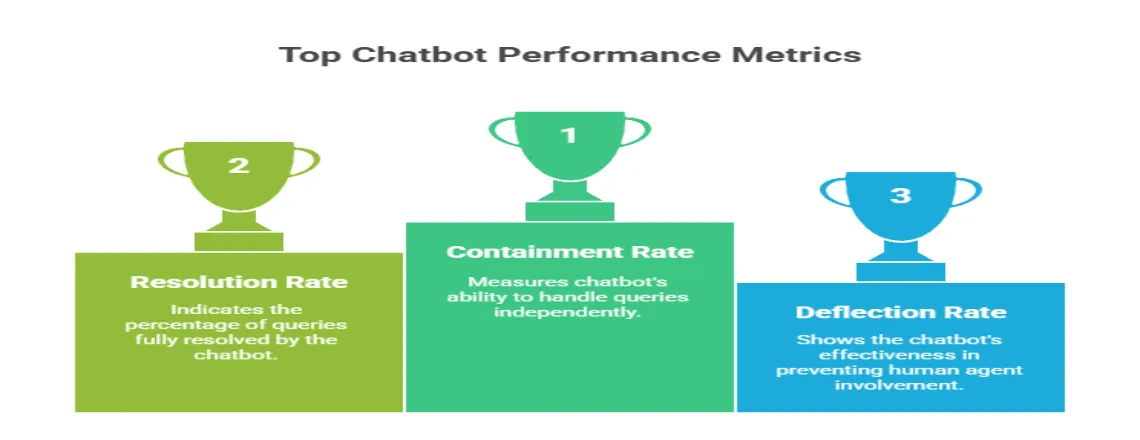
Truly understanding containment rate requires knowing how it connects with other important performance indicators. While containment rate matters tremendously, you need a complete view of chatbot effectiveness.
Containment Rate vs Deflection Rate
Deflection rate measures what percentage of customers who use self-service options instead of reaching out to live support at all. Containment rate tracks how many interactions your bot finishes once they’ve already begun. Consider deflection as prevention, containment as resolution. Both are significant, but they measure different phases in the customer journey.
Containment Rate vs Escalation Rate
Escalation rate is basically containment’s opposite – showing what percentage of conversations get transferred to human agents. When you have a 75% containment rate, your escalation rate is 25%. Tracking both reveals when your bot struggles with particular query types.
Containment Rate vs Resolution Rate
Resolution rate measures actual customer satisfaction with the outcome, whereas containment rate just tracks whether the bot handled it independently. You might have high containment combined with low resolution if your bot delivers incorrect answers. Always track both to ensure quality matches efficiency.
How Containment Impacts Other Metrics
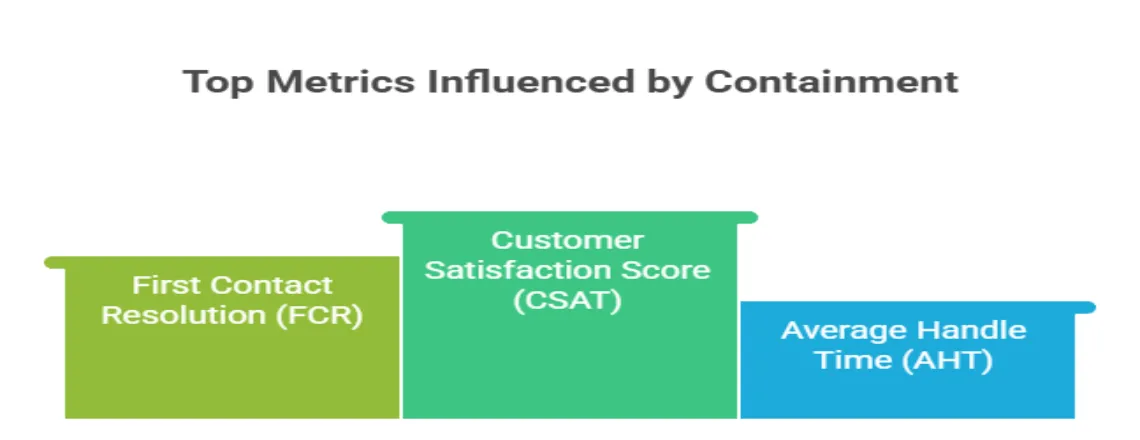
- Customer Satisfaction Score (CSAT): High containment usually boosts CSAT when bots deliver accurate, quick resolutions. But forced containment with inadequate answers destroys satisfaction scores.
- First Contact Resolution (FCR): Containment directly feeds FCR. The bots that effectively solve issues on first contact, pushing FCR rates higher.
- Average Handle Time (AHT): Strong containment dramatically reduces AHT for your support team because fewer interactions need human involvement.
- Net Promoter Score (NPS): Seamless bot experiences that successfully contain queries add positively to overall customer loyalty and NPS.
- Customer Effort Score (CES): When bots contain queries smoothly, customers expend less effort obtaining help, directly improving CES ratings.
The sweet spot? Balancing containment with quality. Track these metrics together every month to guarantee your automation enhances the overall experience, not just one isolated number.
Chatbot Containment Rate Benchmarks Across Industries

Customer service chatbots that perform well typically land somewhere in the chatbot containment rate benchmark sweet spot between 70-90%. These figures vary quite a bit depending on industry complexity and the particular use cases involved.
Industry Breakdown
1. E-commerce & Retail: 70-85%
- Key Applications: Order tracking, returns, product info, account management
- Notes: Simple, straightforward queries perform beautifully with automation. Complex product recommendations still really benefit from human expertise, though.
2. Banking & Financial Services: 65-80%
- Key Applications: Balance inquiries, transactions, card activation, basic account service
- Notes: Security protocols and compliance requirements necessitate human verification for certain sensitive interactions, no matter what.
3. Telecommunications: 75-90%
- Key Applications: Technical support, plan information, billing, service activation
- Notes: Technical troubleshooting follows pretty clearly defined paths, which allows higher containment rates overall.
How AI and Machine Learning Improve Chatbot Containment Rate
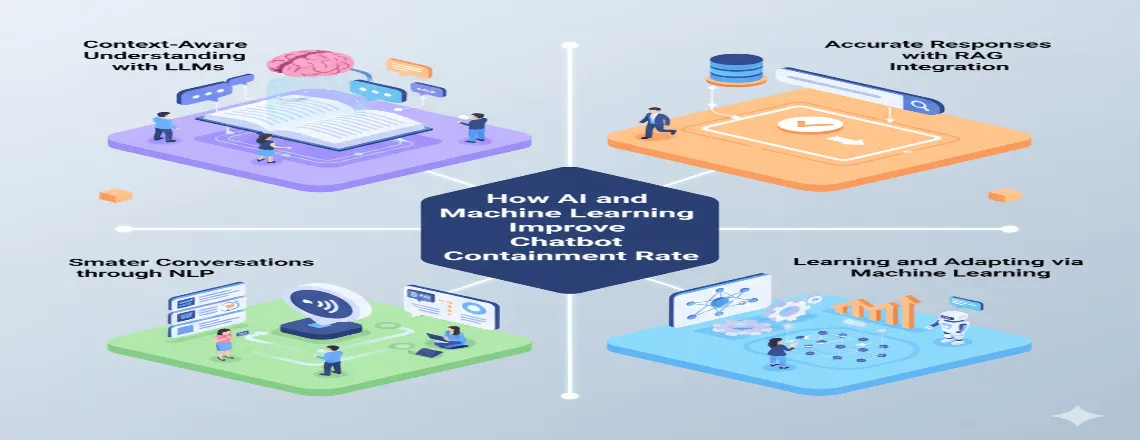
Modern chatbots aren’t all created equal. The technology powering your bot determines how effectively it can resolve user queries without human handoff. Here’s how advanced AI drives higher containment rates:
Context-Aware Understanding with LLMs
Large Language Models (LLMs) outperform traditional intent classifiers by understanding the meaning behind words, not just exact matches. This contextual comprehension boosts containment rates by 15–30%, as bots handle natural, varied phrasing more effectively.
Accurate Responses with RAG Integration
Retrieval-Augmented Generation (RAG) combines LLM intelligence with your knowledge base. Instead of guessing, it retrieves verified data before responding. That real-time accuracy builds user trust and minimizes escalations caused by misinformation.
Smarter Conversations through NLP
Modern NLP models enhance intent recognition, entity extraction, and sentiment detection. They manage slang, typos, and multi-turn context, allowing chatbots to respond naturally and keep users engaged—key to sustaining high containment.
Learning and Adapting via Machine Learning
Machine learning systems analyze each interaction to identify failure patterns and successful resolutions. This feedback loop continuously trains the chatbot, ensuring steady containment growth instead of post-launch stagnation.
Best Practices for Improving Your Containment Rate Chatbot Performance
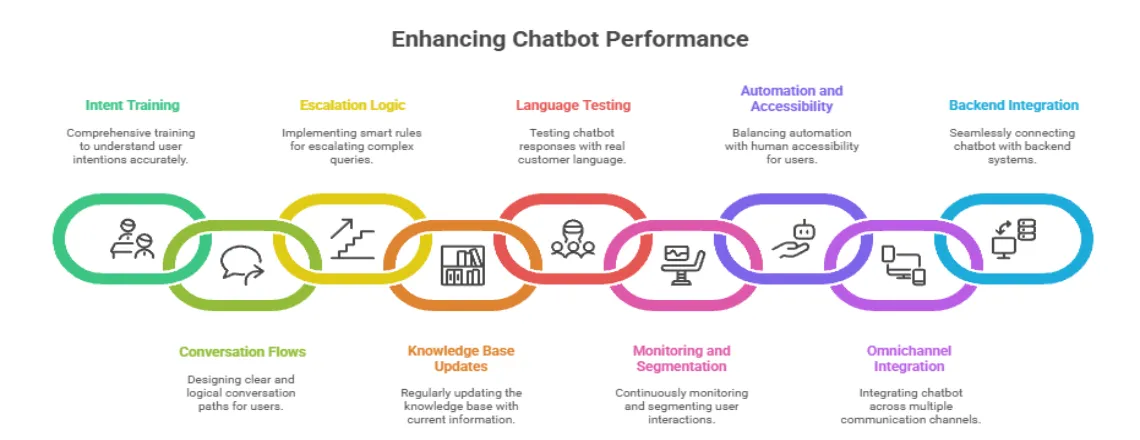
Achieving strong containment rates requires intentional design and constant refinement – you can’t just set it and forget it:
Comprehensive Intent Training
Dig deep into your historical support data and identify your top 20-30 query types. These usually account for roughly 80% of your total incoming volume. Train exhaustively on these high-frequency intents using multiple different phrasings, synonyms, and natural variations people actually use. Master these common queries completely before expanding to other areas.
Clear Conversation Flows
Map out complete conversation paths for each intent you’re supporting. Anticipate follow-up questions, edge cases, and error states that will inevitably appear during real usage. Design logical question sequences that smoothly guide customers toward resolution while maintaining escalation options available when genuinely needed.
Smart Escalation Logic
Develop clear rules that identify conversations needing human touch: high frustration signals, sensitive topics, complicated scenarios, or VIP customers. Graceful escalation that transfers full context to agents creates lasting customer trust.
Continuous Knowledge Base Updates
Regularly analyze escalated conversations to discover system gaps you’re missing. When identical questions cause repeated escalations, add them to your training set within 48 hours maximum. Monthly reviews ought to reveal at least 3-5 new intents or improvement opportunities.
Real Customer Language Testing
Extract actual conversation transcripts, social media mentions, and support tickets to understand the real language patterns customers are using. Train specifically for customer vocabulary and phrasing, including slang, abbreviations, typos, and casual conversational habits people have.
Constant Monitoring and Segmentation
Track your containment rate daily or weekly – monthly reporting honestly misses too much crucial detail. Segment your data by conversation type, customer segment, and time-of-day patterns. Monitor first contact resolution, customer satisfaction score, and escalation rate right alongside containment metrics to get the full picture.
Balanced Automation and Accessibility
Make human escalation accessible without highlighting it too prominently in the interface. Customers should know they can reach a real person when necessary, but your bot should solve problems effectively on the first attempt. Find the right balance between automation efficiency and human availability.
Omnichannel Integration Strategy
Deploy your chatbot across multiple touchpoints – website, mobile app, Facebook Messenger, WhatsApp, Instagram. Ensure consistent performance and knowledge across every channel. Customers switching between devices should experience seamless continuity without needing to repeat information.
Backend System Integration
Connect your chatbot to CRM systems, order management platforms, appointment schedulers, and billing systems through APIs. Real-time data access enables bots to:
- Retrieve order status instantly
- Update account information
- Process simple transactions
- Schedule appointments automatically
- Pull customer history for personalization
Deep integrations can increase containment 25-40% by enabling genuine self-service actions customers actually want.
Top Tools and Platforms for Tracking Containment Rate
Selecting the right chatbot platform dramatically impacts your ability to track and optimize containment rates. Here are the leading solutions:
Comprehensive Chatbot Platforms
1. Chatboq
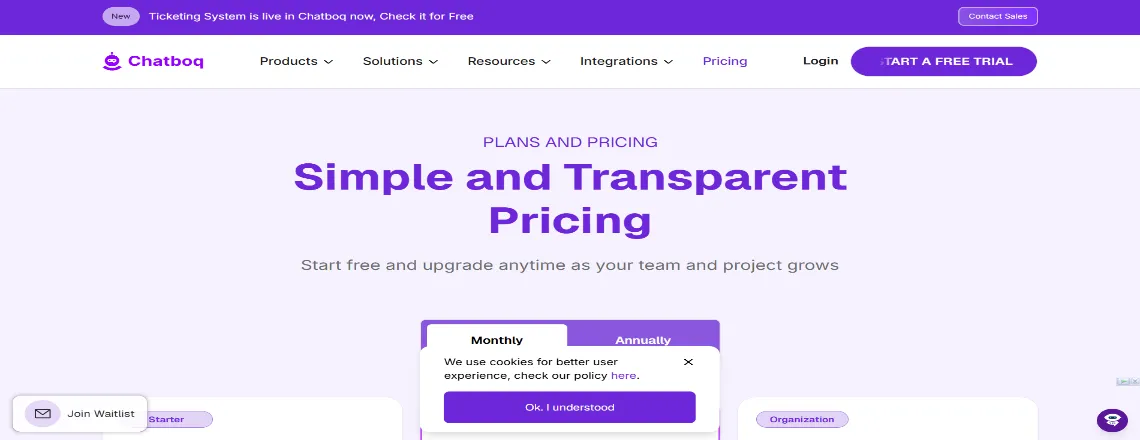
Chatboq is an AI-powered chatbot platform with advanced containment rate tracking, real-time analytics dashboards, and seamless integration capabilities. Excellent for businesses seeking comprehensive conversational AI solutions with detailed performance metrics. Pricing: Free to $389/monthly
2. Botpress
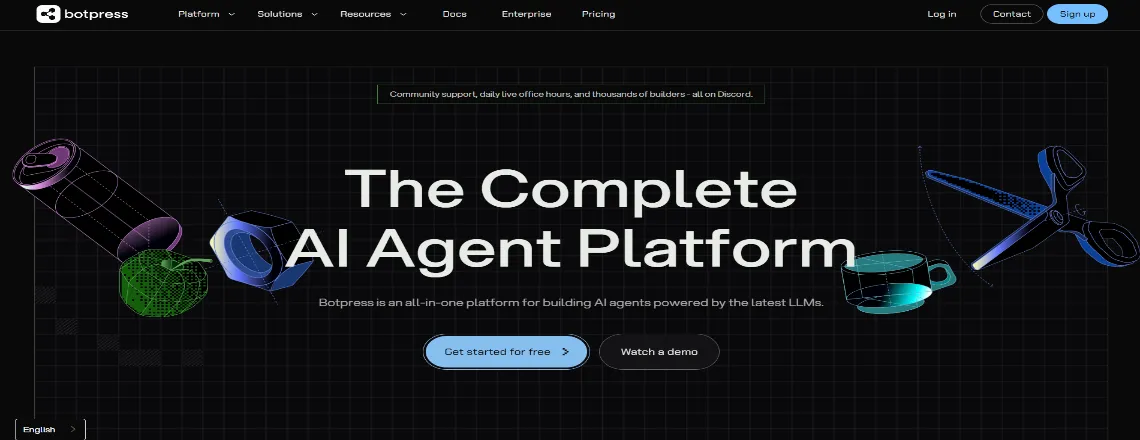
Enterprise-grade platform with built-in containment analytics, LLM integration, and visual flow builder. Strong choice for developers needing customization. Pricing: Enterprise (custom)
3. Tidio
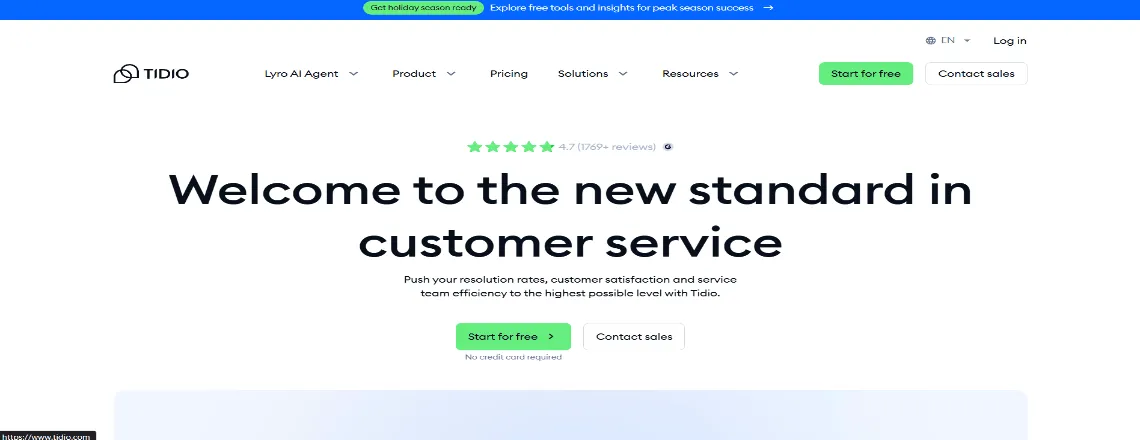
User-friendly platform with real-time containment dashboards, A/B testing, and multichannel support. Excellent for small to mid-size businesses. Pricing: Free to $499/month
4. Kommunicate
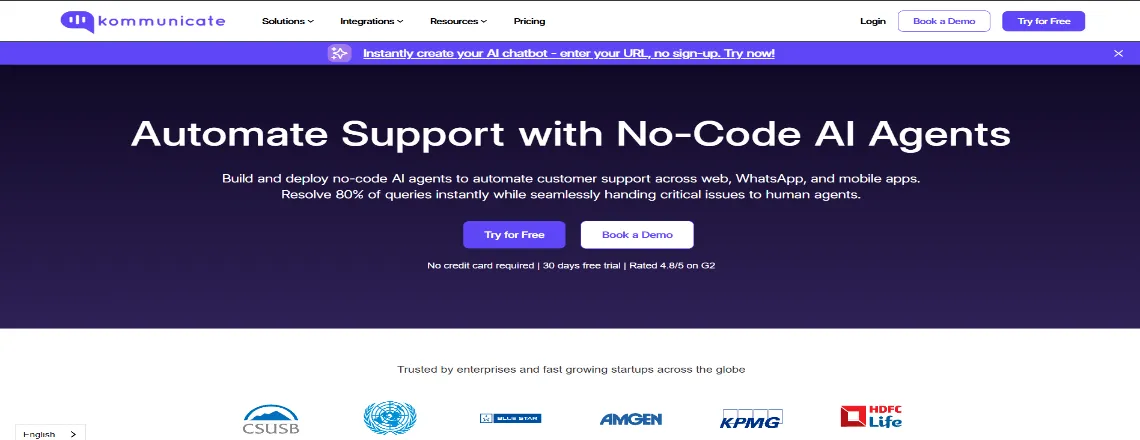
Focuses on hybrid AI-human workflows with detailed containment metrics and CSAT integration. Strong for companies prioritizing smooth escalation. Pricing: $100-$500/month
5. LiveChatAI
AI-powered solution with automatic containment tracking and knowledge base suggestions. Simple setup for non-technical users. Pricing: $29-$499/month
Analytics and Integration Tools
- Google Analytics Integration: Track bot interaction data alongside website metrics. Monitor how containment influences bounce rate, time on site, and conversion rates.
- CRM Integrations: Chatboq, Salesforce, HubSpot, and Zendesk integrations allow tracking containment by customer segment, value, and journey stage.
Custom Dashboards – Most platforms provide dashboard builders for tracking:
- Real-time containment rates
- Escalation trends by query type
- Resolution time distributions
- Customer satisfaction correlation
- Agent handoff reasons
Key Features to Look For
When evaluating platforms, prioritize:
- Automatic containment calculation built into analytics
- Escalation reason tracking to identify improvement areas
- A/B testing capabilities for optimizing conversation flows
- Session replay to understand where conversations fail
- Export capabilities for deeper analysis in BI tools
- Alert systems that notify you of containment drops
Most modern platforms include these features, but implementation quality differs significantly.
Common Challenges and How to Address Them
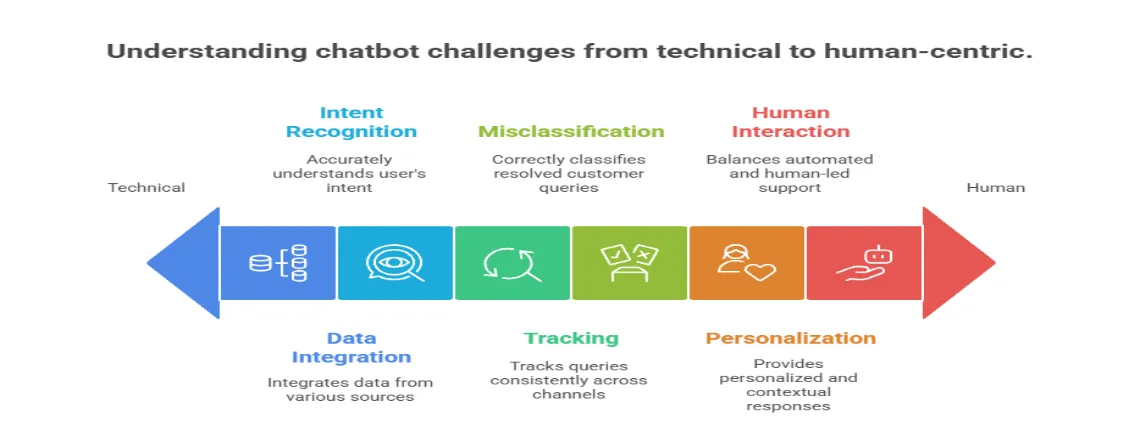
Even well-designed chatbots encounter these predictable obstacles:
Intent Recognition & Natural Language Understanding Issues
When bots consistently misinterpret queries or require exact phrasing from users, containment tanks. This results from inadequate training data or poorly defined, overlapping intents that confuse the system.
Solution: Prioritize natural language processing accuracy before expanding capabilities everywhere. Train extensively on diverse linguistic patterns, including entity recognition, to extract actual meaning from varied customer phrasings. A bot that perfectly understands 10 intents crushes one that poorly handles 50 different ones.
Data & System Integration Limitations
Knowledge base gaps and restricted backend system access stop bots from providing complete information or completing transactions, which forces unnecessary escalations.
Solution: Establish rapid content update workflows that function properly. Add new information within 48 hours of identifying gaps appearing. Prioritize system integrations – order management, CRM, appointment systems – based specifically on query volume to enable genuine self-service actions customers actually want.
Customer Preference for Human Interaction
Some customers instantly demand agents regardless of bot capability, often because previous terrible experiences with automated systems have scarred them.
Solution: Demonstrate real value immediately from the beginning. Lead with first responses that provide genuinely useful information right away. Show customers your bot actually helps rather than creating frustrating obstacles to human support access.
Lack of Personalization and Context
Generic, robotic responses that completely ignore customer history destroy perceived helpfulness and dramatically spike escalation requests.
Solution: Integrate customer data properly for real personalization. Address customers by their actual name, reference their account history, and customize suggestions based on their past behavior patterns. Maintain conversation context across multi-turn interactions to prevent that repetitive information-gathering that drives people absolutely crazy.
Misclassification of Resolved Queries
Bots marking conversations “resolved” when customers aren’t actually satisfied distorts your containment metrics and conceals real problems.
Solution: Implement post-conversation satisfaction surveys. Track customer behaviors after “resolved” conversations – do they immediately reach out again through another channel? Adjust your resolution criteria based on actual customer satisfaction, not simply bot completion.
Inconsistent Tracking Across Channels
Different measurement methods between websites, mobile apps, and social media channels generate unreliable data.
Solution: Standardize tracking procedures across all platforms. Use unified analytics tools that aggregate data consistently. Ensure all channels feed into a single source of truth for accurate reporting.
Using User Feedback to Improve Chatbot Containment Rate
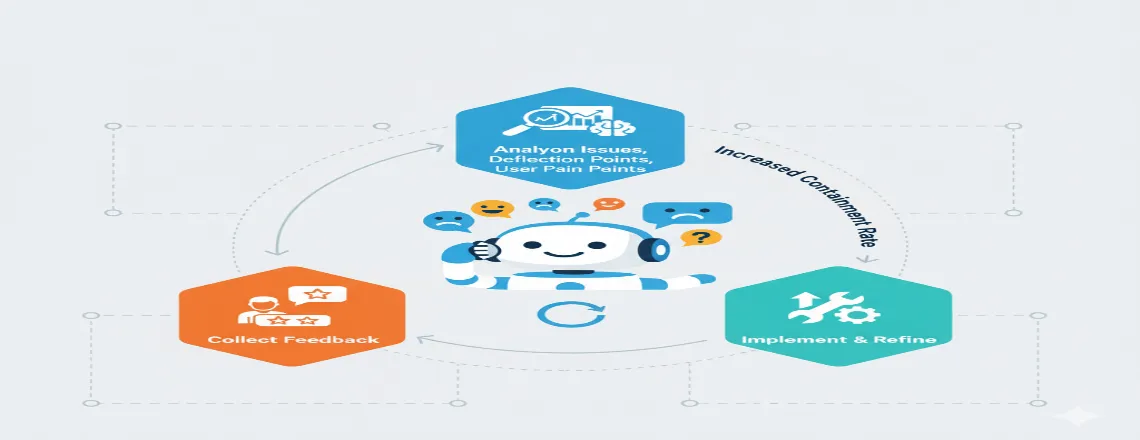
Optimizing containment rates isn’t a one-time project as it’s an ongoing process fueled by customer feedback and data analysis.
Implementing Feedback Loops
- Post-Conversation Surveys: Add quick satisfaction ratings after bot interactions. Simple thumbs up/down or 1-5 star ratings deliver immediate feedback on resolution quality.
- Message-Level Feedback: Let customers rate individual responses as helpful or unhelpful. This identifies exactly where your bot succeeds or fails within conversations.
- Sentiment Analysis: Deploy sentiment detection throughout conversations. Flag interactions where frustration increases – these often signal containment failures before escalation happens.
- Exit Surveys: When customers abandon bot conversations, ask why. Common reasons expose specific improvement opportunities.
Analyzing Feedback for Action
Review feedback weekly to identify patterns:
- Which query types consistently generate negative feedback?
- Where do customers abandon conversations most often?
- What phrases trigger escalation requests?
- Which responses receive the highest satisfaction ratings?
Use these insights to:
- Update knowledge bases with missing information
- Refine conversation flows around friction points
- Train models on successful resolution patterns
- Eliminate responses that consistently underperform
A/B Testing Conversation Flows
Don’t guess what works – test it. Run A/B tests on:
- Different greeting messages
- Varied question sequences
- Alternative escalation triggers
- Multiple response phrasings for common queries
Track which variations achieve higher containment while maintaining satisfaction scores. Roll out winners across your bot.
Creating Improvement Cycles
Establish monthly improvement cycles:
- Week 1: Analyze performance data and user feedback
- Week 2: Identify 3-5 specific improvement opportunities
- Week 3: Implement changes and deploy updates
- Week 4: Monitor impact and document results
This systematic approach guarantees continuous containment rate improvements rather than sporadic, reactive fixes.
Success Stories: Companies Winning with High Containment Rates

E-Commerce: 85% Containment, $480K Annual Savings
A major online retailer concentrated their bot exclusively on order-related queries – tracking, modifications, returns – with deep order management system integration. Training on actual customer language enabled them to autonomously handle 200,000 monthly queries, saving $40,000 monthly. Those savings accumulate rapidly.
Telecommunications: 78% Containment, 22% Satisfaction Increase
A telecom company deployed bots for their 15 most frequent connection and billing issues with detailed troubleshooting paths built in. This slashed average wait times from 12 minutes down to under 3 minutes for escalated interactions, dramatically boosting customer satisfaction scores within just six months.
Conclusion
Chatbot containment rate defines modern customer service success. With industry benchmarks at 70-90%, most companies have room for improvement through systematic optimization.
Perfect containment isn’t the goal; strategic escalation of complex issues to human agents improves satisfaction. The best strategies balance automation efficiency with human expertise where it matters most.
Frequently Asked Questions About Chatbot Containment Rate
Chatbot Containment Rate measures how many customer conversations your chatbot resolves completely without needing human intervention. It reflects your bot’s ability to handle customer queries independently and indicates overall automation success.
You can calculate it using the formula:
Containment Rate (%) = (Conversations Fully Resolved by Bot ÷ Total Conversations Initiated) × 100.
This shows the exact percentage of interactions your bot successfully manages from start to finish without escalation.
Containment Rate (%) = (Conversations Fully Resolved by Bot ÷ Total Conversations Initiated) × 100.
This shows the exact percentage of interactions your bot successfully manages from start to finish without escalation.
It’s a crucial metric that shows how effectively your chatbot reduces human workload, cuts costs, and enhances customer experience. A high containment rate means your automation strategy is genuinely delivering value to both customers and support teams.
Most well-performing chatbots achieve a containment rate between 70% and 90%. The ideal benchmark depends on your industry, bot maturity, and the complexity of customer queries.
High containment allows customers to get instant, accurate answers without waiting for human agents. This reduces frustration, shortens response times, and increases trust in your automated system.
Each successfully contained conversation saves around $5 to $25 in human labor costs. Increasing your containment rate by even 20% can translate to hundreds of thousands in annual savings for mid-to-large companies.
Containment rate measures how many ongoing chats your bot finishes independently, while deflection rate shows how many customers choose automated self-service options instead of reaching live agents in the first place.
Enhance your bot’s NLP understanding, train it using real customer language, integrate backend systems like CRM or billing platforms, and continuously update your knowledge base. Regular testing and user feedback also help refine performance.
Industries like Telecommunications (75–90%) and E-commerce (70–85%) often see higher rates because their queries are structured and repetitive, allowing automation to perform efficiently with minimal errors.
Advanced AI systems such as Large Language Models (LLMs) and Retrieval-Augmented Generation (RAG) boost containment by understanding context better, retrieving accurate company data, and generating human-like responses.

Daniel Wong
Technical Content Writer
My name is Daniel Wong, a Technical Content Writer from Singapore with a strong interest in AI-powered tools and digital automation. At ChatBoq AI, I focus on creating practical and easy-to-follow content that helps businesses and individuals understand how chatbots work and how to use them effectively.
I enjoy breaking down complex topics like natural language processing (NLP) and conversational AI into simple guides that anyone can follow. Each article is based on careful research, real-world examples, and testing to ensure accuracy and reliability.
Through ChatBoq AI, my goal is to provide readers with trustworthy insights, step-by-step tutorials, and the latest trends in chatbot technology.
✍️
Expert in AI & Chatbot Technology

Leave A Comment